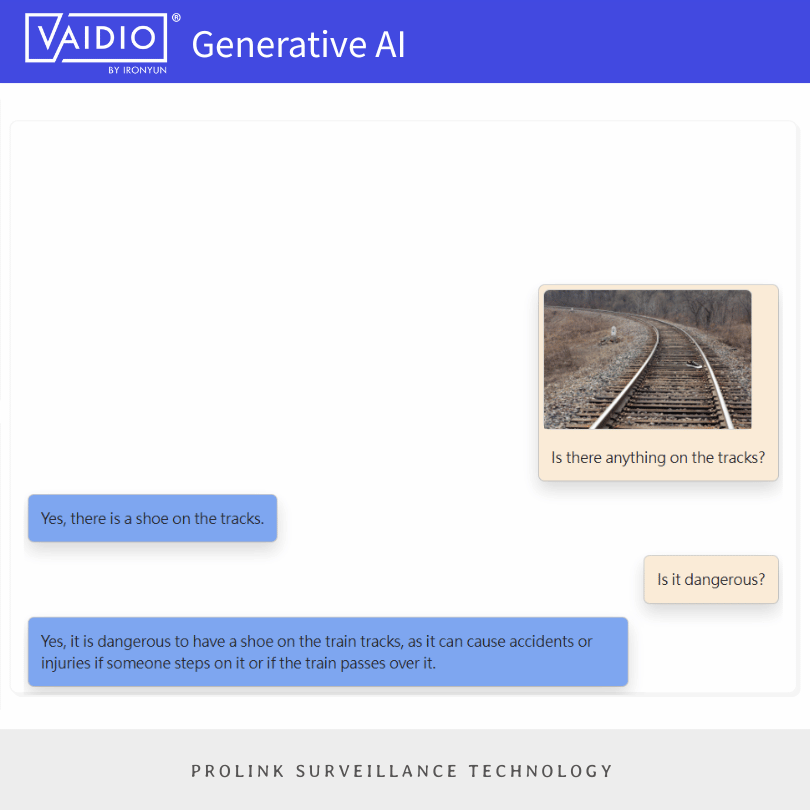
In an era where we “ask ChatGPT whatever comes to mind,” we've grown accustomed to usingnatural language to ask questionsand getting instant answers, without spending ages searching for information.
Whether it's emotional support, trip planning, or deciding what to eat for dinner tonight, this intuitive way of interacting has quietly changed our relationship with technology.
Now, this same experience is starting to extend into how surveillance systems are operated.
We previously coveredthe differences between traditional AI and generative AI(👉Further Reading), but in a world full of change and unpredictability, traditional AI struggles to anticipate every scenario.
This is precisely why Vaidio GenAI was created — so that video surveillance is no longer limited to seeing only “pre-defined scenarios,” but can understand what is actually happening behind the scene.
Generative AI Solves What Traditional Surveillance Can't Understand
After incorporating traditional AI technology, surveillance systems gained real-time recognition and proactive alerting capabilities, no longer serving as simple recording tools and significantly reducing the need for manual monitoring.
Common traditional AI applications include:
- People counting, crowd detection, heat map analysis
- License plate recognition, double-yellow-line crossing, wrong-way driving violations
- Flame and smoke detection
- PPE detection (such as helmets and reflective vests)
- Virtual fence intrusion detection for critical areas
However, these functions mostly rely on predefined conditions and large volumes of labeled data, requiring model training to work effectively, and are suited to handlingknown, fixed, and predictableevents.
But in the real world, many events don't look the same each time and are hard to anticipate in advance.
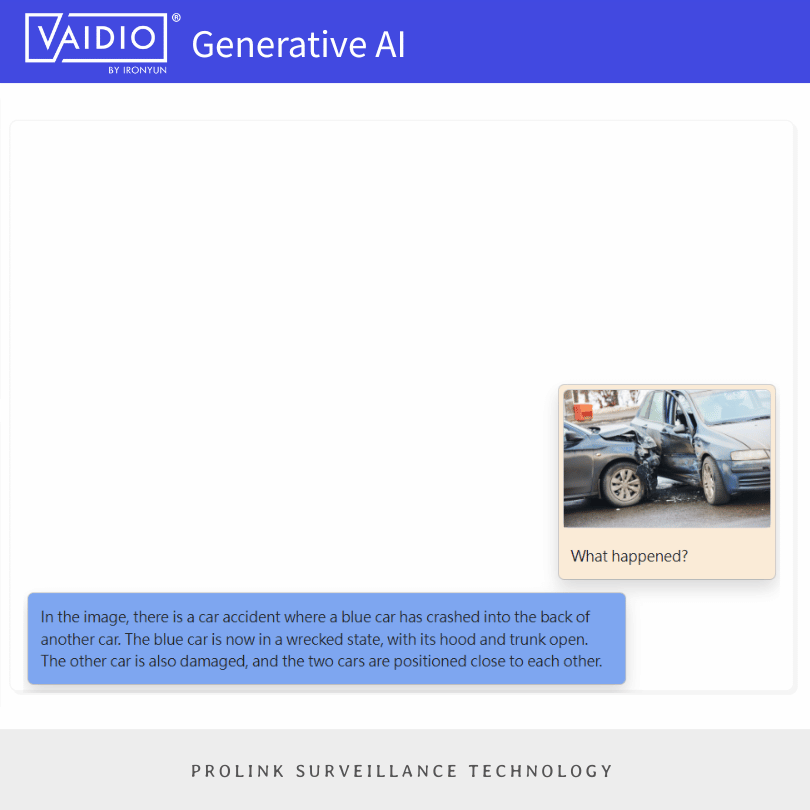
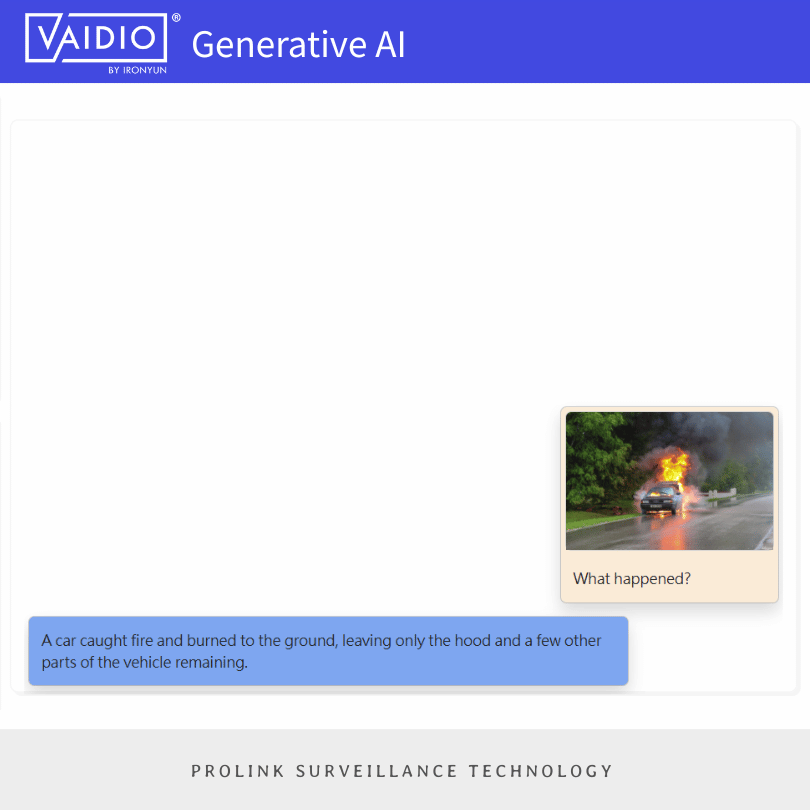
Take traffic accidents as an example: while traditional AI can identify vehicle types (trucks, buses, bicycles, motorcycles, etc.), every accident scenario can be different — the collision angle, body deformation, and surrounding conditions vary endlessly, making it hard to fully cover with fixed rules or labeled examples.
Scenarios like this — with too much variation and rules that are hard to pin down — are exactly what generative AI excels at handling. Even without being told in advance what to look for, it can reason from the scene content to figure out what happened, truly “understanding” the anomalies and conditions in the video.
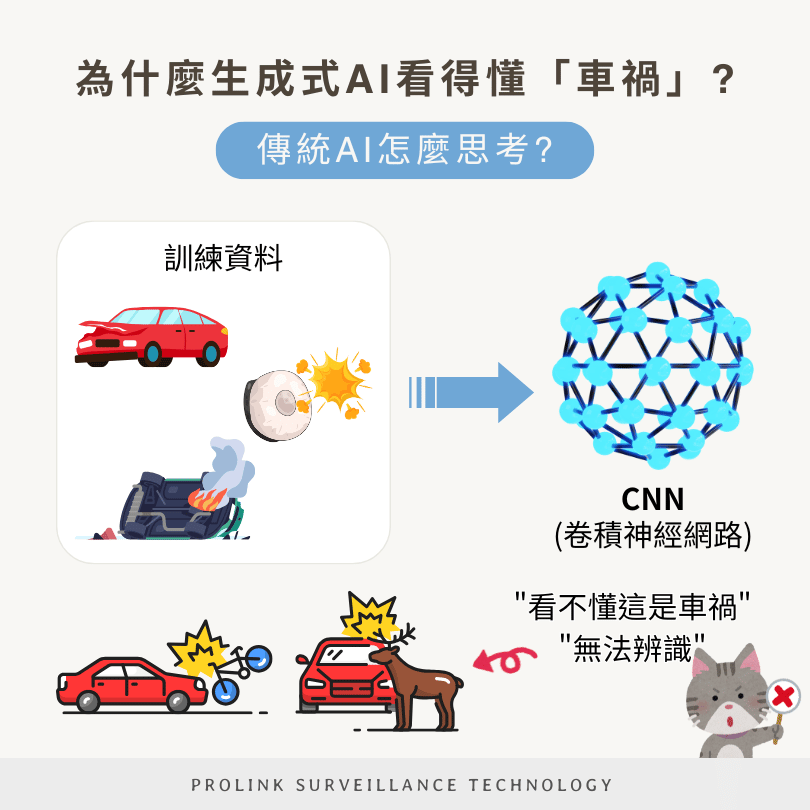
Why Can Generative AI Understand “Traffic Accidents”?
How Does Traditional AI Think?
Using a CNN (Convolutional Neural Network) to train the model, this type of AI:
- Must first be fed large numbers of labeled images (e.g., a crumpled hood, a deployed airbag, an overturned car)
- Can only learn “this is what a car accident looks like” and cannot understand new types of accidents it hasn't seen before
- If it hasn't been trained on cases like “a car hitting a bicycle” or “a car hitting a deer,” it simply “doesn't understand”
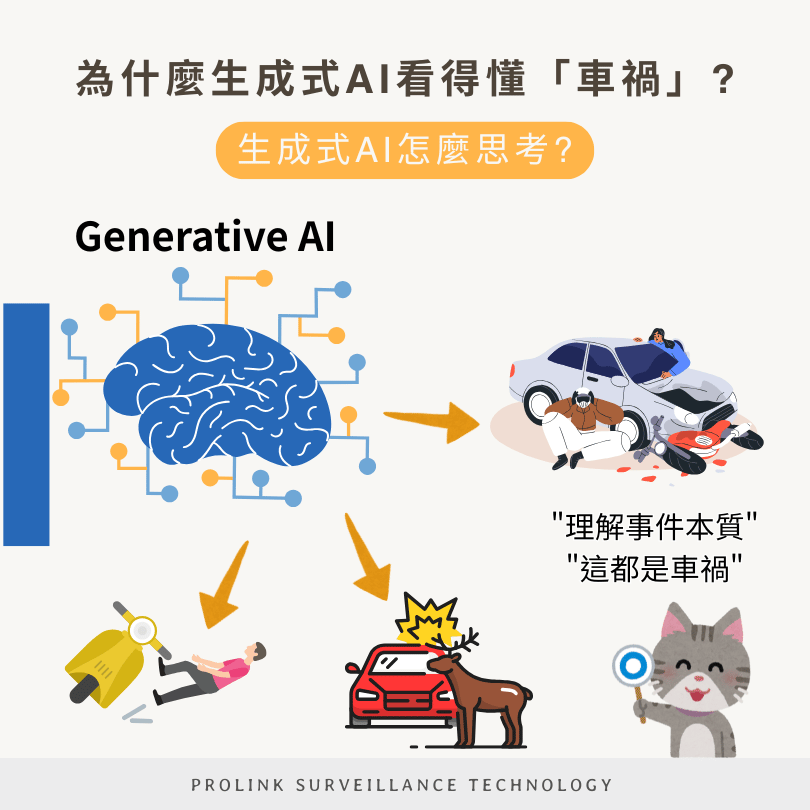
How Does Generative AI Think?
Generative AI, such as what Vaidio GenAI uses, is built on an architecture closer to “semantic understanding” and “event reasoning.” It:
- Doesn't just compare appearances — it understands the nature of the event
- Can understand the full context of an event, such as “rapid vehicle contact → visible deformation → a person on the ground”
- Even without a label saying “traffic accident,” it can reason in language: “This is probably a traffic accident, right?”
🧠 It isn't “looking for an identical image” — it's “judging what this video footage represents happened.”
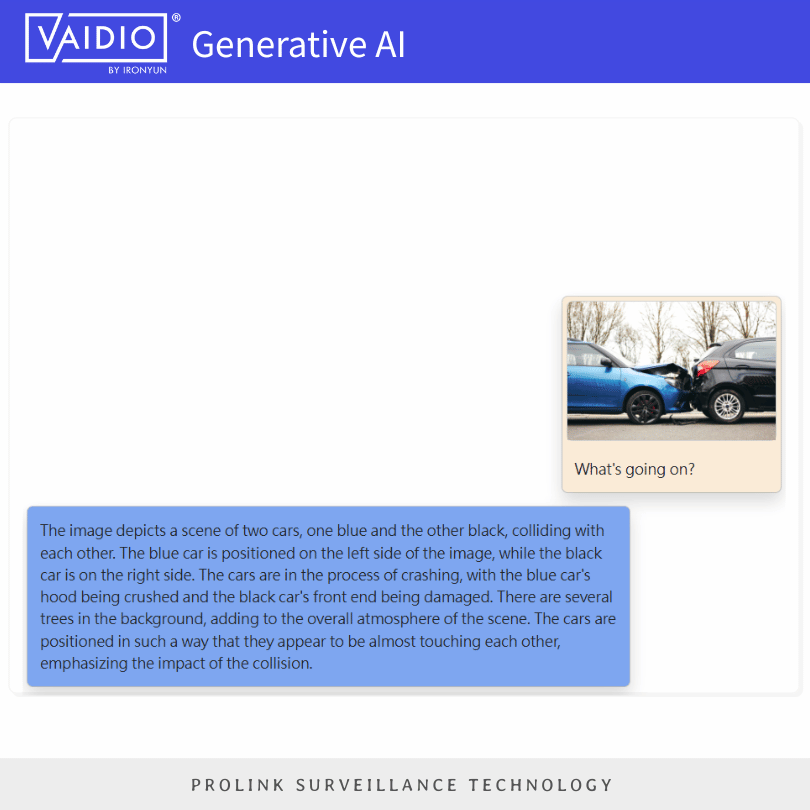
Vaidio Generative AI Is Like ChatGPT — Intuitive and Convenient to Use
The biggest feature of generative AI is that it doesn't rely on fixed logic or appearance labels — it can reason based onnatural languageinput to independently infer the context and changes in a scene.
This intuitive way of asking questions — like asking ChatGPT “What should I have for dinner?” or “Any good-value laptop recommendations?” — can now also be applied to video surveillance.
With Vaidio GenAI, there's no need to write code or have an AI background — you can get started with a single question.
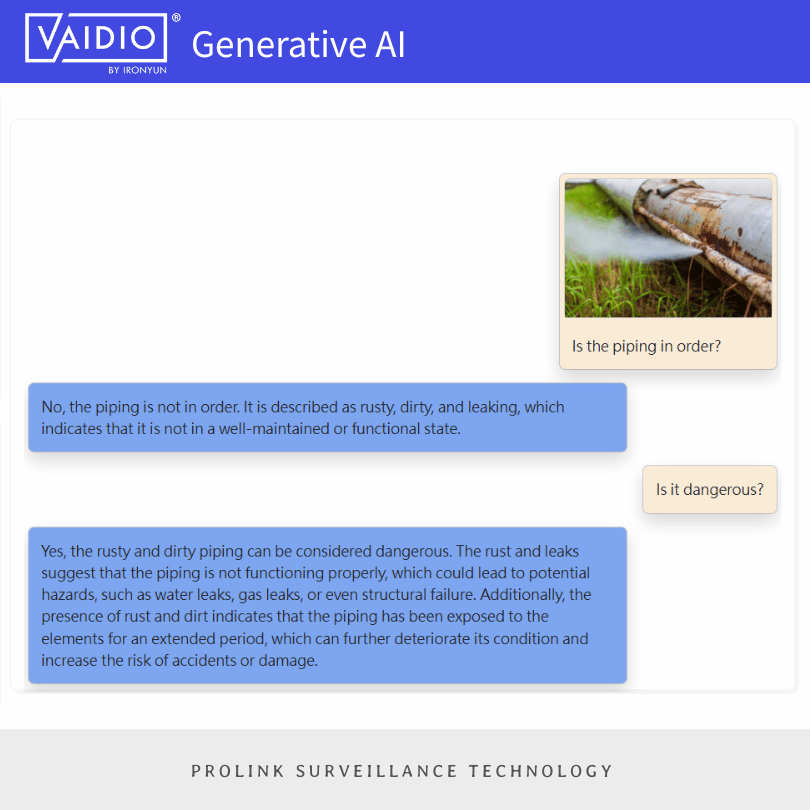
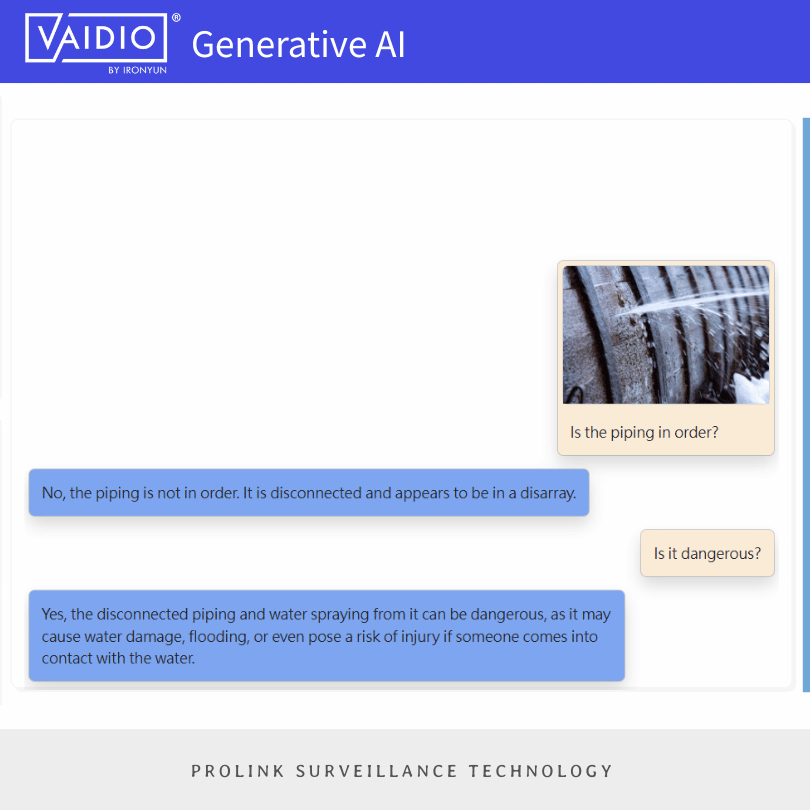
For example: “What did this person do?” or “Is the pipe leaking oil?” You can even keep asking different questions to progressively track down the truth of an event — the system reasons from the scene content and context whether the event is occurring, and finds the video clip you're looking for.
You don't need to teach it how to judge — it can “understand the scene” on its own, just like asking ChatGPT something you don't know and having it find the answer for you.
More Than Just Questions — It Can Also “Take on Tasks” for Proactive Detection
Besides quickly querying past footage through questions, Vaidio GenAI also supports “task-based alerting.”
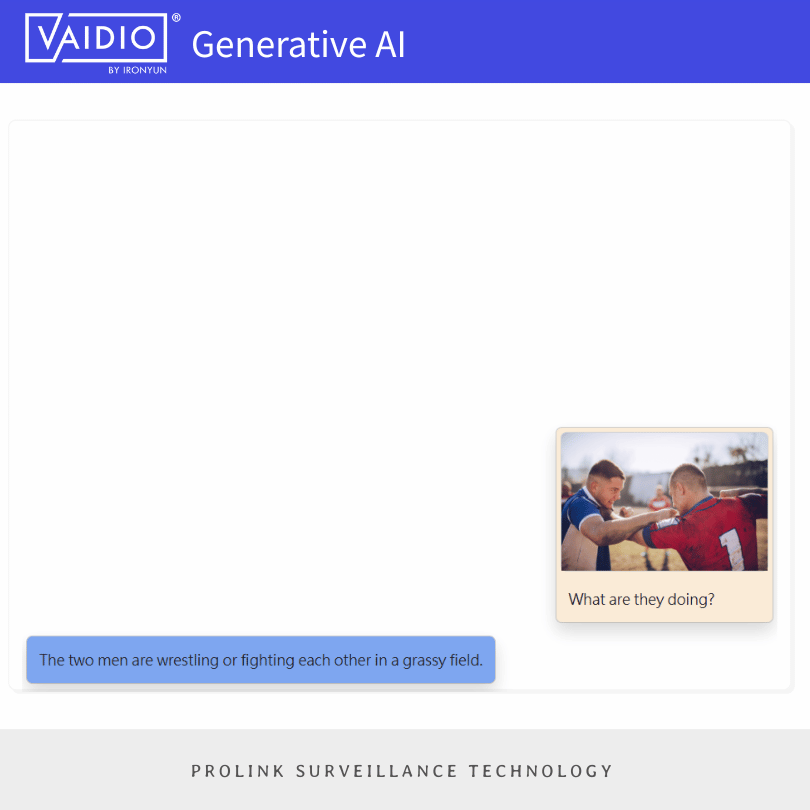
You can simply enter a condition, such as “Detect fighting,” and the system will continuously analyze and understand the surveillance footage, issuing an alert the moment a fight is detected.
This feature may look similar to traditional AI, but the underlying logic is completely different:
Traditional AI must rely on model training and matching specific movements to trigger an alert — once a scene doesn't match, the model simply “doesn't understand” and fails to recognize it.
Vaidio GenAI, on the other hand, understands the scene — like having a tireless specialist on duty 24/7, continuously judging whether an abnormal event is genuinely occurring.
Real-World Scenarios Vaidio GenAI Excels At
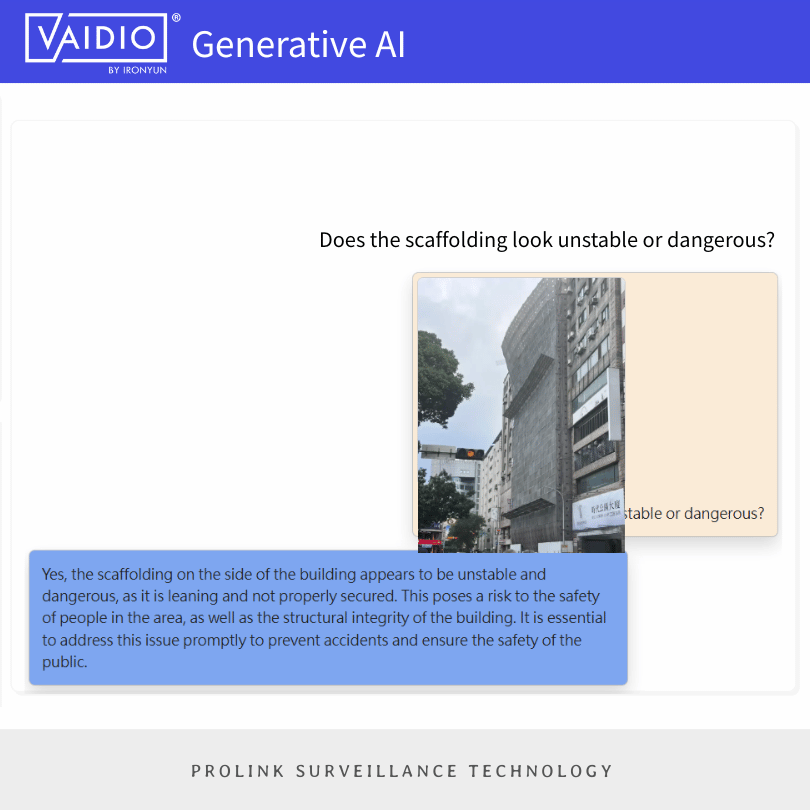
Tilted Construction Scaffolding
Pipeline Damage at a Plant (Oil Leaks, Gas Leaks, Rust)
Traffic Accidents in Transportation
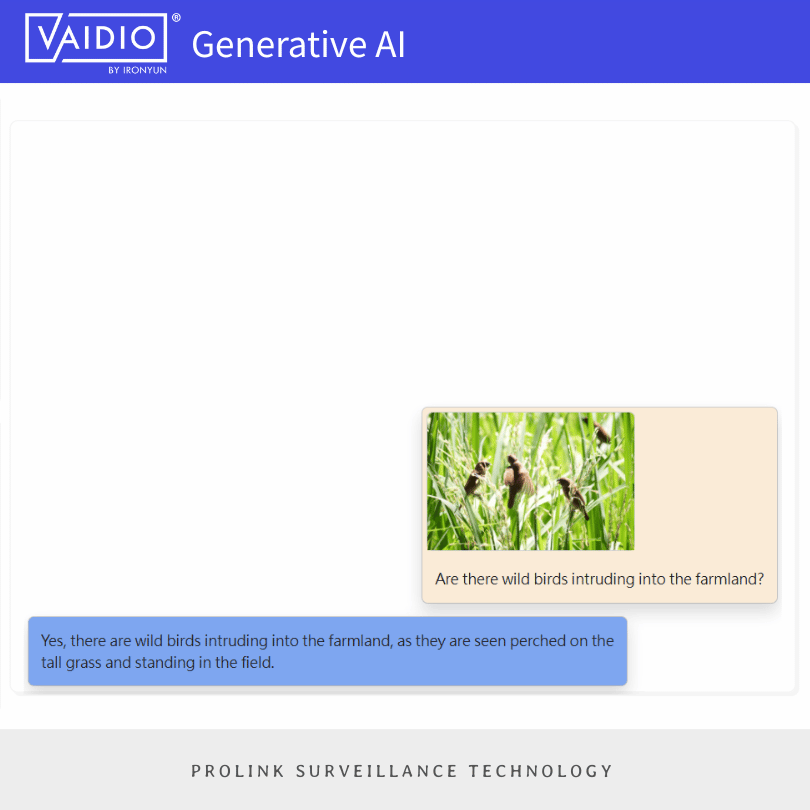
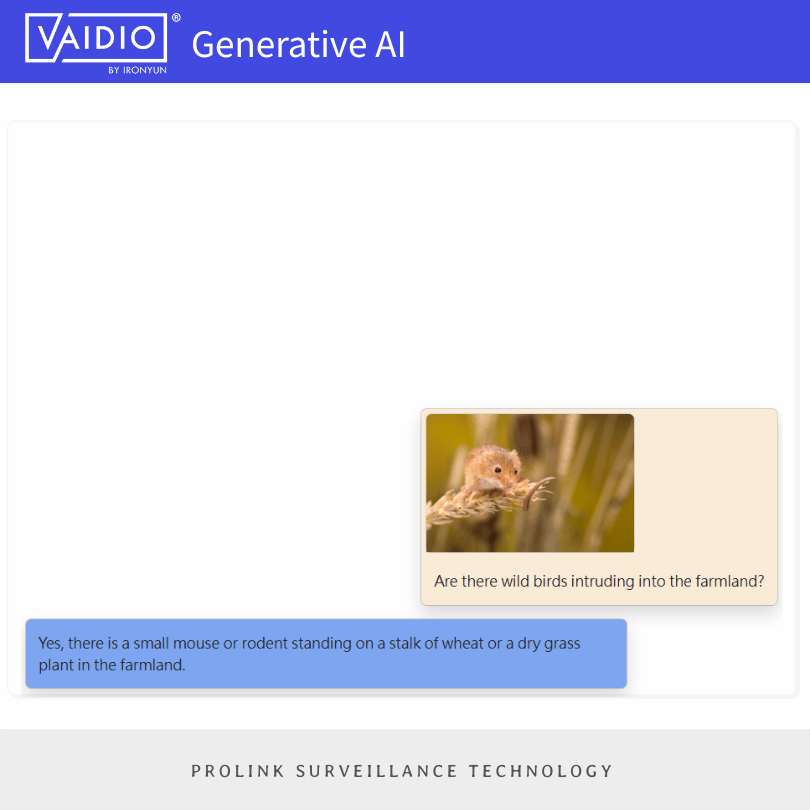
Wildlife Intrusion in Farmland
Fight Detection Without Fixed Logic
Preventing Foreign Object Intrusion on Railway Tracks