Already have cameras installed? No need to replace equipment — start accurate people counting right away!

Store Foot Traffic
In retail store operations,"foot traffic"is one of the most basic yet most important metrics.
Foot traffic represents the total number of people entering a store, serving as a key basis for estimating conversion rates and revenue trends.
But with so many people-counting methods on the market, how do you choose?
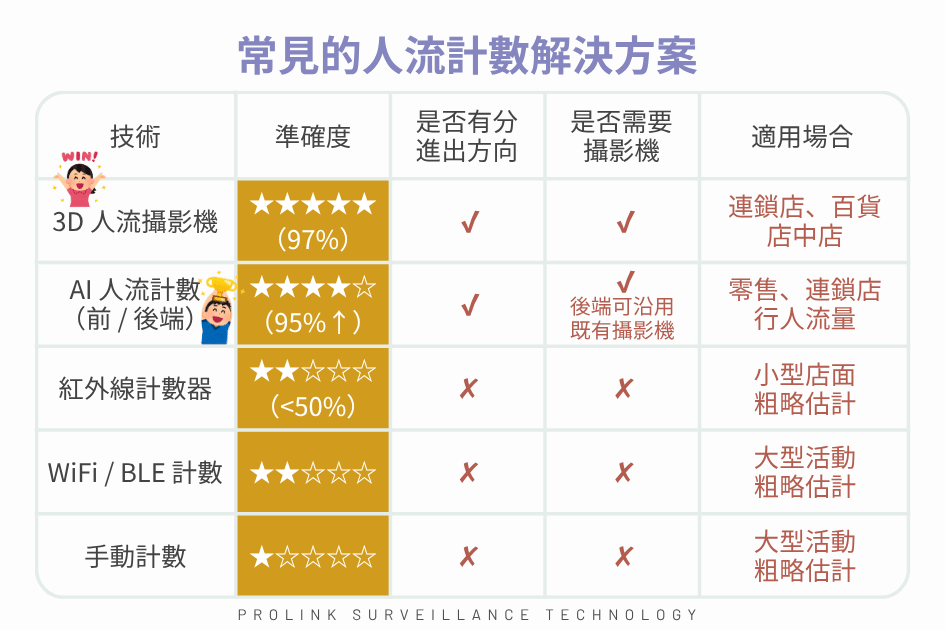
Below is a quick comparison table of the most common store people-counting methods:
Common People-Counting Solutions
▋3D People-Counting Camera
- How It Works:
Uses dual-lens stereo parallax to measure object depth, accurately counting the number of people passing through an entrance. Installation requires checking ceiling height, distance from the door frame, and entrance width, and the camera is typically mounted on the ceiling directly above the entrance. - Pros:
✔ Extremely high accuracy (about 97%)
✔ Distinguishes entry and exit direction
✔ Height filtering excludes children under 120 cm with no purchasing power
✔ Recognizes loitering zones to avoid double-counting
✔ Works at night
✔ Provides a real-time in-store people count - Cons:
✘ Requires wiring and drilling; ceiling conditions must be assessed before installation
Best For:
Retail stores, chain stores, department store counters, shop-in-shop
→ Related Reading: How a Well-Known E-Commerce Apparel Brand Doubled Sales with "Precision People Counting" — A Case Study in Turning Retail Data into Revenue
▋AI People Counting (Edge / Server-Side)
- How It Works:
Edge approach: Uses an AI camera with a built-in people-counting model that performs the calculation directly on the device.
Server-side approach: Pairs existing cameras with AI people-counting software that analyzes the footage and performs the count. - Server-Side AI Counting Pros:
✔ No need to replace existing cameras, lowering adoption cost
✔ No extra wiring needed
✔ Freely draw counting zones and lines in any direction based on the camera's angle
✔ Works at night
✔ Over 95% recognition rate (depending on image quality, angle, and lighting) - Server-Side AI Counting Cons:
✘ Requires good camera image quality; poor resolution or angle reduces accuracy
✘ If the camera angle is too steep, people appear too small, or backlighting is severe, repositioning is needed - Best For:
Retail stores, chain stores, department store counters, shop-in-shop, pedestrian flow analysis
▋Infrared Counter
- How It Works:
Infrared sensors installed on both sides of an entrance count +1 whenever someone passes through and breaks the beam. - Pros:
✔ Low cost
✔ Quick installation - Cons:
✘ Only counts the number of passes; cannot distinguish entry from exit
✘ Cannot count if the infrared endpoints are blocked
✘ Prone to errors from occlusion during crowded periods
✘ Cannot provide a real-time in-store headcount
✘ Accuracy is typically below 50% - Best For:
Micro storefronts, situations requiring only a rough estimate
▋Wi-Fi Scanning and Bluetooth Counting
- How It Works:
Estimates headcount by capturing the probe signals phones emit while searching for Wi-Fi, along with Bluetooth broadcasts. - Pros:
✔ Can track dwell time
✔ Can roughly estimate repeat visit rate - Cons:
✘ Cannot detect devices with Wi-Fi/Bluetooth turned off
✘ One person may carry multiple devices, giving moderate accuracy
✘ May raise privacy and regulatory concerns - Best For:
Locations unsuitable for cameras, large events, mall corridors
▋Manual Counting
- How It Works:
On-site staff use handheld clickers, or manually observe and estimate, to tally foot traffic. - Pros:
✔ Simple to operate
✔ No extra equipment to set up - Cons:
✘ Prone to human error such as missed or duplicate counts
✘ Staff are too busy during peak hours to record accurately
✘ Cannot track entry/exit direction
✘ Data isn't traceable and can't support long-term analysis - Best For:
Small storefronts, situations requiring only a rough estimate
At this point, you might be thinking:
"We already have cameras in our store — do we really need new equipment and rewiring?"
Not necessarily.
When adopting people counting, many store owners worry most about disruptive installation work affecting operations.
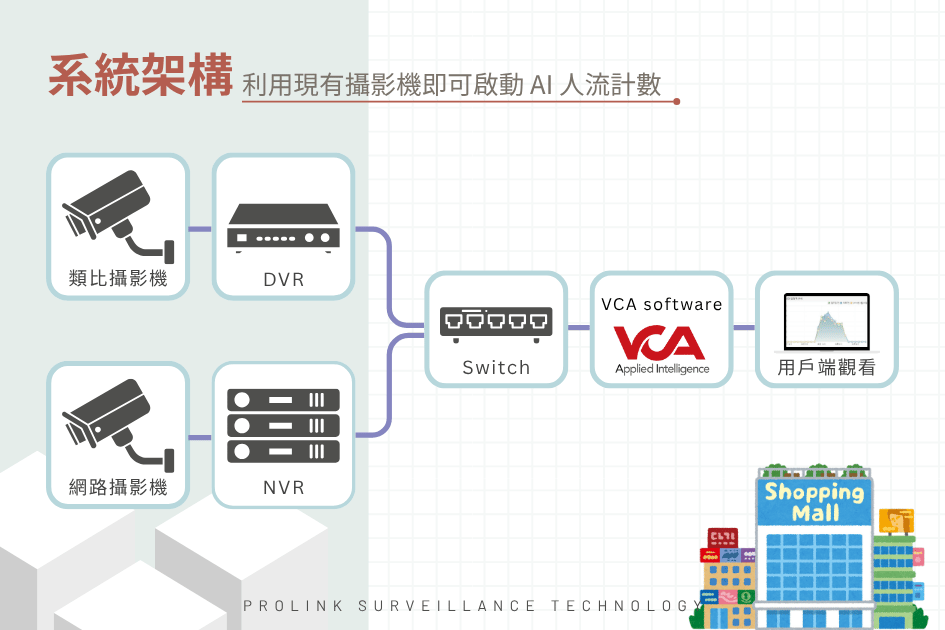
But if your site already has CCTV, VCA AI server-side analytics can start counting foot traffic directly from your existing footage — no need to replace hardware or touch the ceiling and wiring.
VCA AI People-Counting System Architecture
How Do Existing Cameras Connect to AI?
Custom Zones and Directions, Suited to Any Site Layout
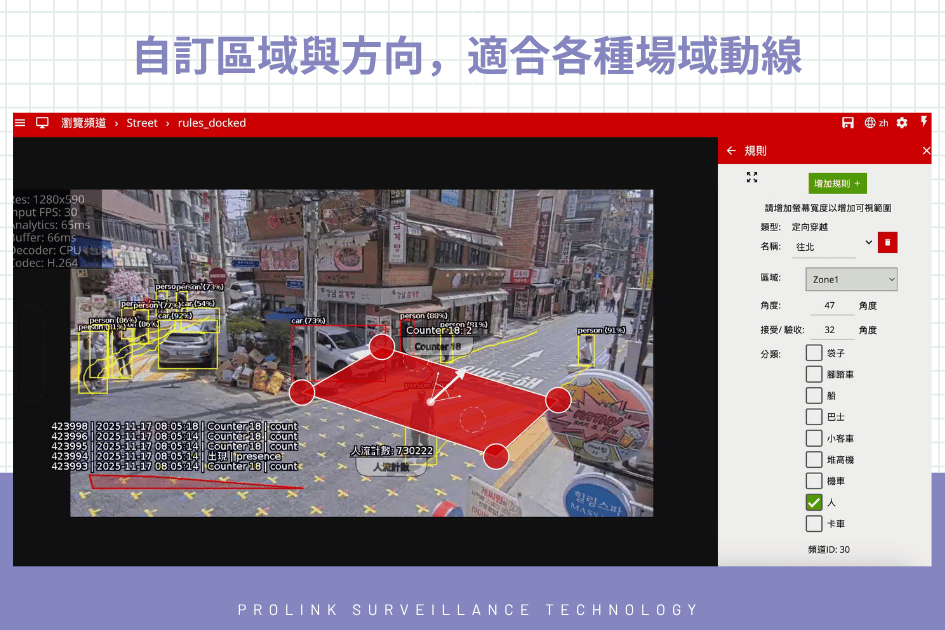
The VCA backend lets users define custom zones and directions. Since every site has different entrance locations and traffic flow, users can freely draw counting zones and set entry/exit directions to match their specific site, creating a counting method tailored to the location.
Turning Video Into Data
In the past, reviewing surveillance footage meant relying on gut feeling:
"This anniversary sale seems busy?"
"This time slot looks busier?"
But the footage only shows people moving around — it doesn't reveal the actual foot traffic count.
With AI-powered data analysis,
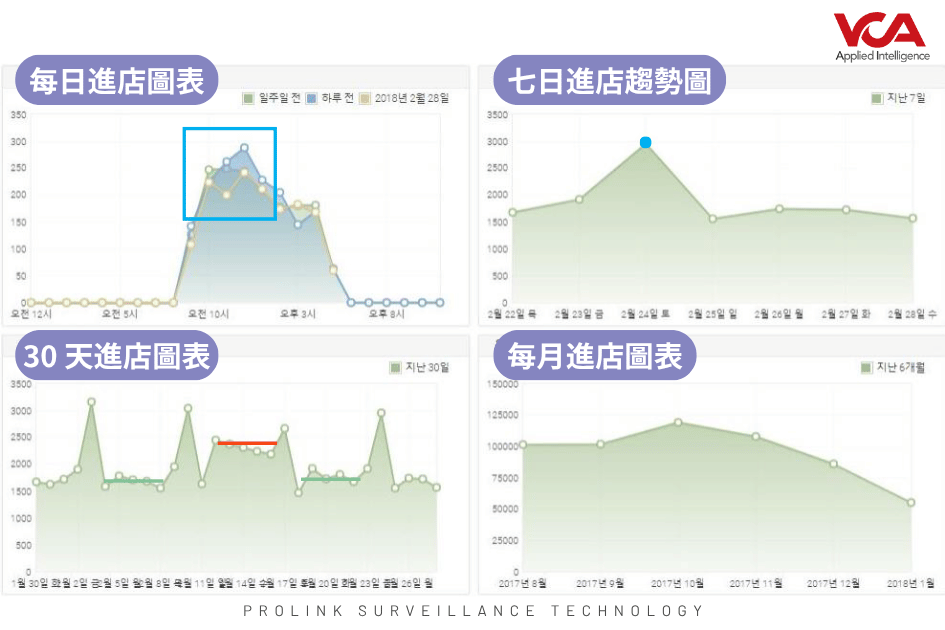
daily headcounts, trends, and peak hours are all clearly displayed at a glance.