

As AI becomes widespread and people grow used to asking ChatGPT or Gemini a question and getting an accurate, logical answer within seconds, it's natural to assume: “If ChatGPT can 'teach itself' to answer, then AI software for smart security surveillance should also find it easy to learn to recognize new objects, right? After all, isn't AI supposed to learn on its own?”
But did you know that ChatGPT and Gemini, which appear to “teach themselves,” actually rely on a rigorous deep learning training process behind the scenes — they don't genuinely grow on their own.
The illusion of being “understood” arises simply because the training data and language patterns are designed to feel more human — not because the model actually possesses consciousness.
Giving AI this level of understanding and responsiveness comes at an extremely high cost.

AI's “Learning” Is Actually a High-Cost Engineering Effort
To build a model's comprehension, it must first be fed massive volumes of data, trained using tens of thousands of NVIDIA GPUs. A singletraining run can cost tens of millions to over a hundred million US dollars, and the electricity consumed throughout the training phase could power thousands of office buildings running simultaneously.
While the details aren't public, model sizes are generally estimated to range from hundreds of billions to over a trillion parameters. The fine-tuning phase requires extensive manual labeling and calibration, making it the most time-consuming and expensive part of training.
Every conversation with ChatGPT is, in fact, a cloud inference computation, continuously consuming substantial power and resources behind the scenes.
AI's Value Comes From Efficiency
Likewise, AI video recognition used in smart security surveillance must go through a series of deep learning processes and repeated training to achieve accurate recognition.
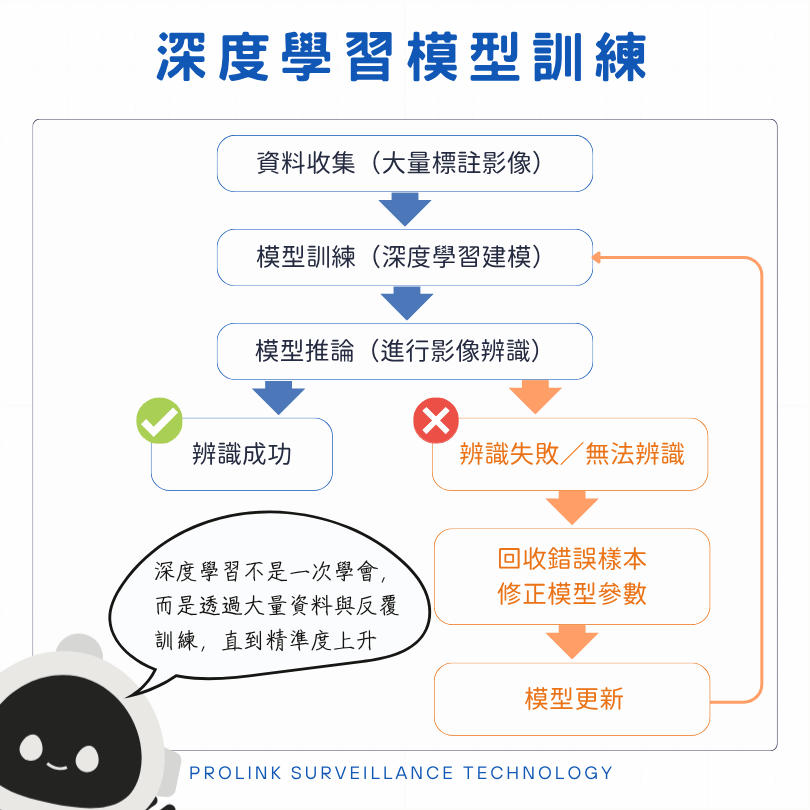
AI's value doesn't come only from the technical investment behind it — it lies in its ability to boost efficiency, freeing people to focus on decision-making rather than repetitive judgment calls.
ChatGPT can offer its service at a subscription price because its cost is spread across hundreds of millions of users; every conversation actually consumes cloud computing resources and a significant amount of token processing.In the smart security field, our AI models are purpose-built for security tasks, and the training costs involved are just as real — only here, the focus is on prevention upfront, to avoid losses and property damage after the fact.
Three Recognition Modes of Smart Security AI Video Recognition Software
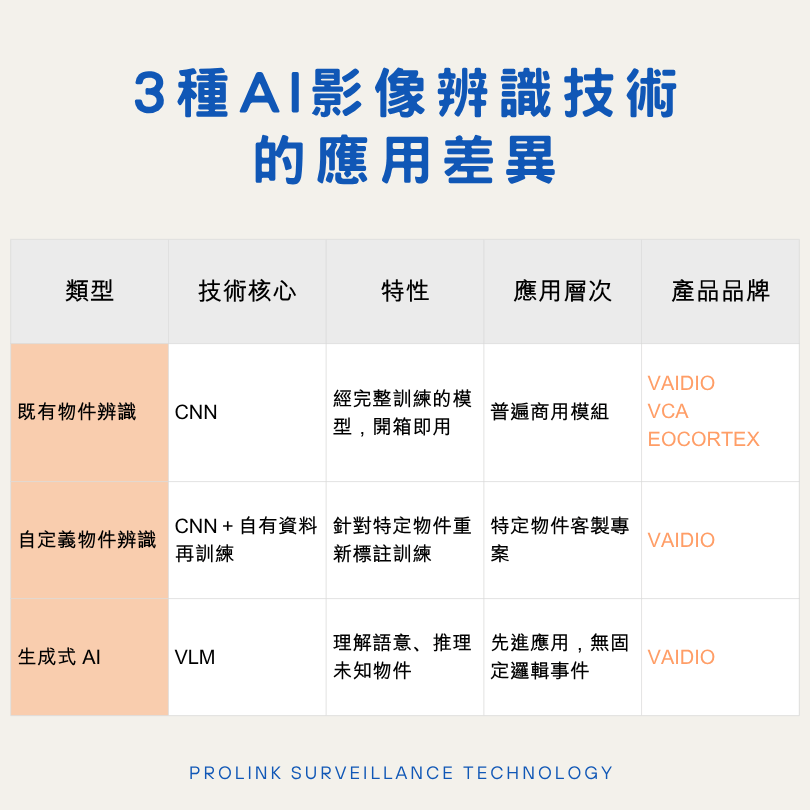
In the smart security field, AI video recognition can be broadly divided into three types:Pre-trained object recognition, custom object recognition, and generative AI.
While all three are built on deep learning, they differ in the amount of data required, training cost, and scope of application.
1. Pre-Trained Object Recognition
Built on a CNN (Convolutional Neural Network) architecture, this is currently the most widely used and mature AI video recognition technology.
The system comes with multiple fully trained models that can recognize more than 50 common object types (referring to VAIDIO here), such as people, vehicles, animals, and objects, enabling real-time, stable recognition.
It offers an out-of-the-box capability that can be applied directly to a wide range of surveillance scenarios without additional training, supporting various behavior and event detection functions such as smoke and flame detection, people counting, PPE detection, fall detection, and intrusion detection.
2. Custom Object Recognition
Also based on a CNN architecture, this approach is mainly used to train recognition of specific targets not included in the pre-trained object list.
Users can upload their own images, label the location and name of the object to be recognized, and through repeated training and correction, gradually teach the model to recognize the new object.
For example, to get the system to recognize an object like a “chair” that isn't in the pre-trained model, a large number of image samples from multiple angles and environments must be provided for effective training, since camera footage is flat rather than the 3D vision the human eye perceives.

Many people intuitively assume: “A person who has seen a chair can recognize any chair, so AI should be able to as well.”
In reality, AI cannot naturally generalize or draw inferences the way humans do. It must go through extensive training and repeated correction to learn to recognize the same object across different angles and environments.
A model's recognition accuracy typically starts at a basic level and gradually improves to a stable, usable standard as more data is added and training iterations accumulate.

Custom training isn't a one-time process — it's an ongoing cycle of optimization. If the same image is used repeatedly for training, the model will only “memorize” that photo rather than truly learn the object's features.
Data collection, labeling, training, and correction must therefore be repeated continuously so the model can reliably recognize the object's shape and distinguishing features.
3. Generative AI
Generative AI can recognize objects of non-fixed form or unpredictable nature, performing reasoning and judgment without the need for pre-labeled data.
Built around a VLM (Vision-Language Model) core, it combines video recognition with natural language understanding, allowing the system to “comprehend” the events and relationships in a scene through semantic reasoning.
Vaidio's generative AI is built on OpenAI and NVIDIA technology, compressing a VLM model with up to 7 billion parameters for inference, significantly reducing compute requirements and energy consumption while maintaining recognition accuracy.
Compared to traditional CNN models,it can handle rare events for which large sample sets cannot be collected, such as sudden accidents, abnormal behavior, or environmental changes.
In practice, Vaidio's generative AI has been deployed in a century-old mountain railway project in Taiwan to detect any abnormal obstacles on the tracks, such as rockfalls, branches, or animals.
Projects like this must balance safety and cost-effectiveness — a deployment of just 10 channels can cost as much as NT$3 million, representing a government-scale investment with both economic scale and public safety benefits.

AI is no longer an unattainable technology — it is a tool that can be tailored to fit different needs and budgets.
For some businesses, pre-trained object recognition is already enough to make operations safer; for large or mission-critical sites, generative AI can uncover subtle clues within vast amounts of surveillance footage.
AI will not replace people, but those who know how to choose and make the most of it will go further.
Let technology be your assistant, not your burden — true intelligence isn't about spending the most money, but about knowing where to invest.