
Vaidio Generative AI Comes to Taiwan's Century-Old Mountain Railway, Enabling New Track Obstacle Detection
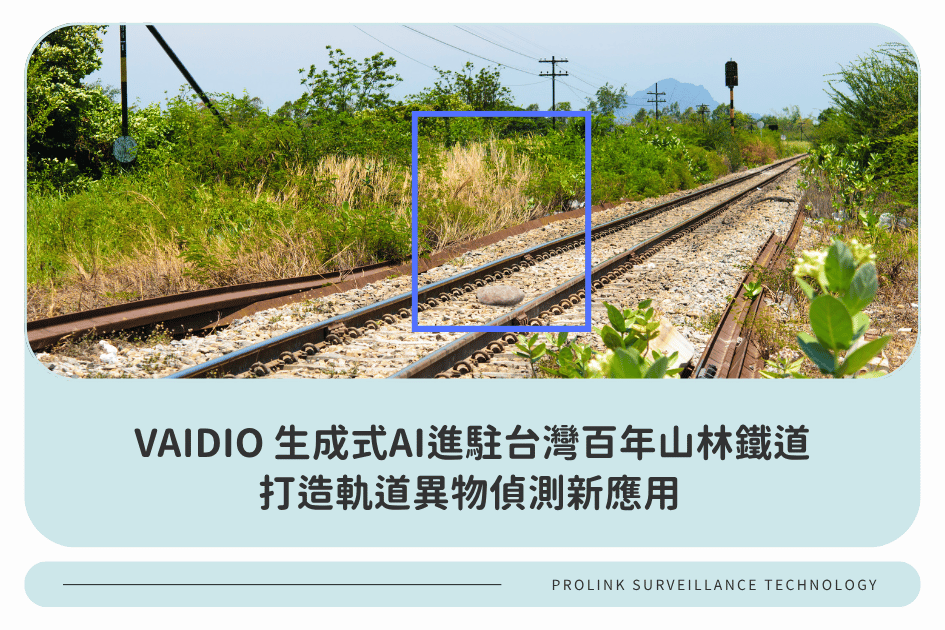
To protect the safety of trains on Taiwan's century-old mountain railway, foreign object detection technology has been deployed along the line to identify potential hazards early. Because the mountainous terrain is complex, branches, falling rocks, animals, or debris can fall onto the tracks at any time. If not identified and cleared promptly, this can lead to accidents as trains enter stations, service disruptions, or even derailment risks.

Among the many foreign object detection technologies available, why did we ultimately choose VAIDIO's generative AI?
Traditional detection methods such as radar, infrared, and pressure sensors can detect anomalies, but can only tell you that something is abnormal, not what it actually is. This lack of detail can lead to false alarms, missed detections, or delayed response.
The introduction of VAIDIO's generative AI was designed to fill this gap, further strengthening the system's ability to recognize and judge, accelerating railway safety towardthe next stage of Intelligent Transportation Systems (ITS) and smart railbecoming a practical reality.
Why not choose traditional discriminative AI?

Traditional discriminative AI is trained on large volumes of labeled data. It requires collecting a large number of images and manually labeling every object type within them (such as vehicles, people, objects, animals, etc.) before a recognition model can be built. For example, VAIDIO itself is capable of recognizing the following object types:
- Vehicles: bicycles, buses, cars, forklifts, jeeps, motorcycles, tricycles, trucks, tuktuks
- People and animals: human heads, people, birds, cats, cattle, dogs, horses, wildlife
- Everyday objects: backpacks, bags, phones, suitcases, strollers, umbrellas, wheelchairs
- Dangerous objects: fire, handguns, knives, rifles, smoke
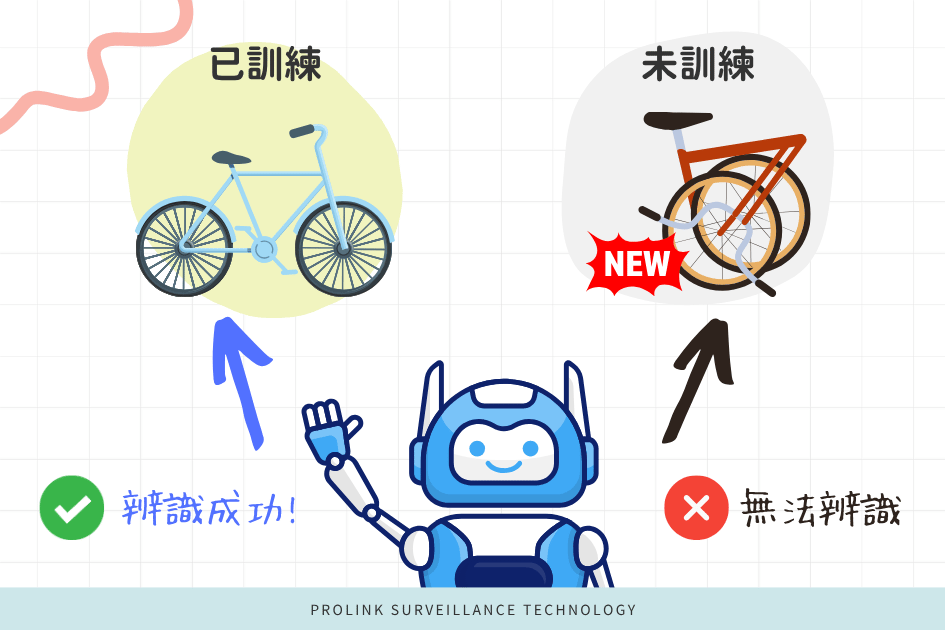
However, this type of AI can only recognize"known objects", so as soon as a new, untrained object appears in the scene, recognition can fail. For example, if a newly released bicycle has a design with a silhouette completely different from anything seen before, traditional discriminative AI may fail to recognize it as a "bicycle" or as a foreign object at all, creating a risk of missed detection.
In real-world applications, the types of objects we encounter are constantly changing and evolving rapidly, and this is exactly where generative AI has the potential to break through.
Generative AI: Automatically Understanding Scenes and Detecting Anomalies in Real Time
VAIDIO's generative AI has a general understanding capability that is closer to human cognition. It can directly interpret a scene without needing every object type to be predefined. Even when a never-before-seen object appears, it can still respond correctly by understanding the background and context.
Its advantages include:
- Can recognize objects of non-fixed shapes and types
- Requires no pre-labeled training data for recognition, saving development and training costs
- Built on large language model technology, effectively reducing computing power requirements
- Combines OpenAI and NVIDIA technology, trained on a massive dataset with 7 billion parameters for more comprehensive recognition
- Can perform logical reasoning using natural language
- Can identify objects that are difficult to collect in large quantities
More importantly, VAIDIO's generative AI runs on edge devices on-site, delivering fast response times without needing to send video back to the cloud for a decision, enabling real-time handling of foreign object events, which is critical for rail safety.

Foreign Object Detection on Railway Tracks
VAIDIO GenAI vs. Radar: Field Test Results
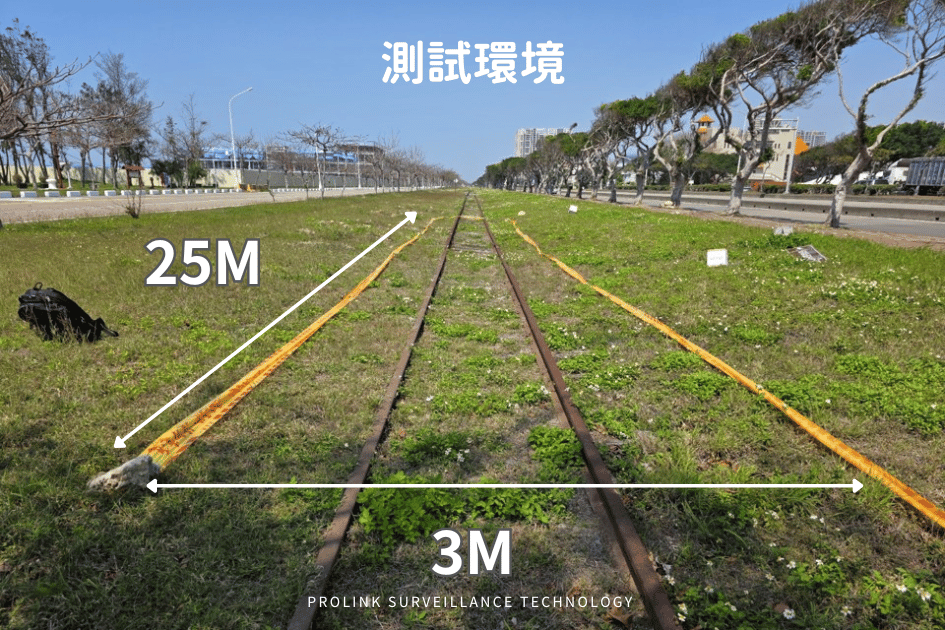
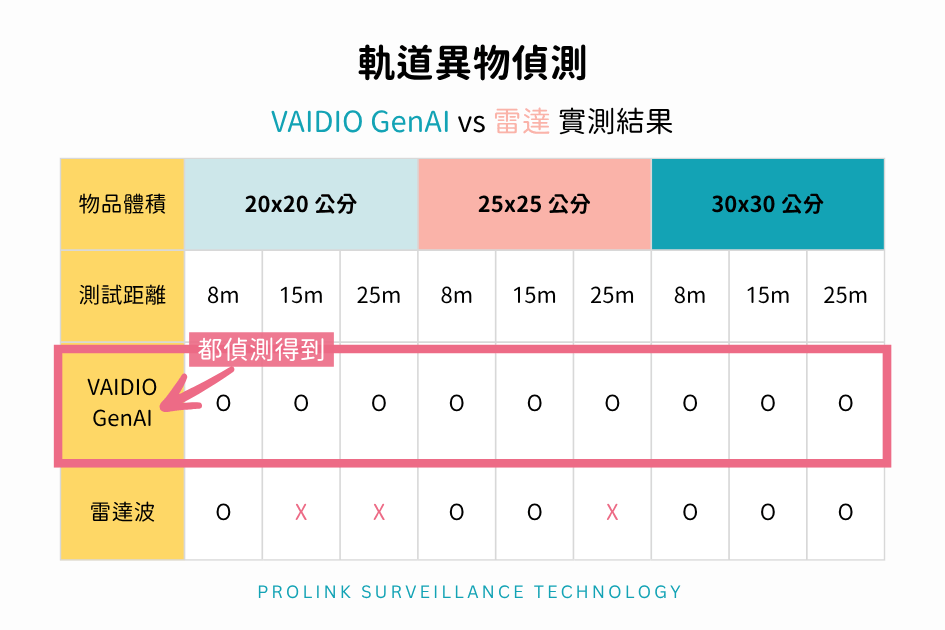
To verify the real-world performance of VAIDIO's generative AI, we conducted field tests for railway foreign object detection and compared the results against radar technology, which is commonly used on airport runways and train tracks, evaluating the performance difference between the two across various object sizes and detection distances.
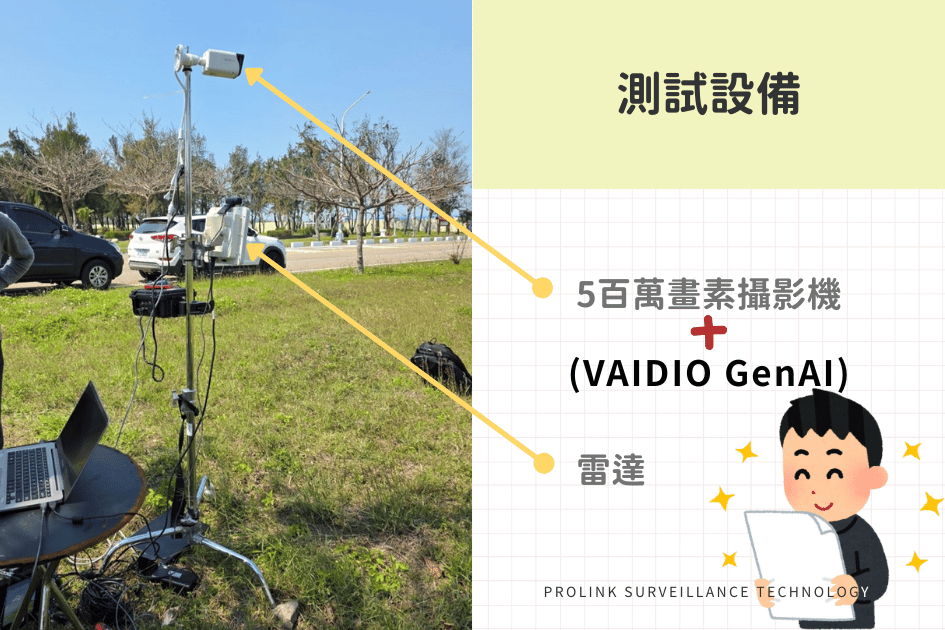
Test Details
VAIDIO GenAI Recognition Test
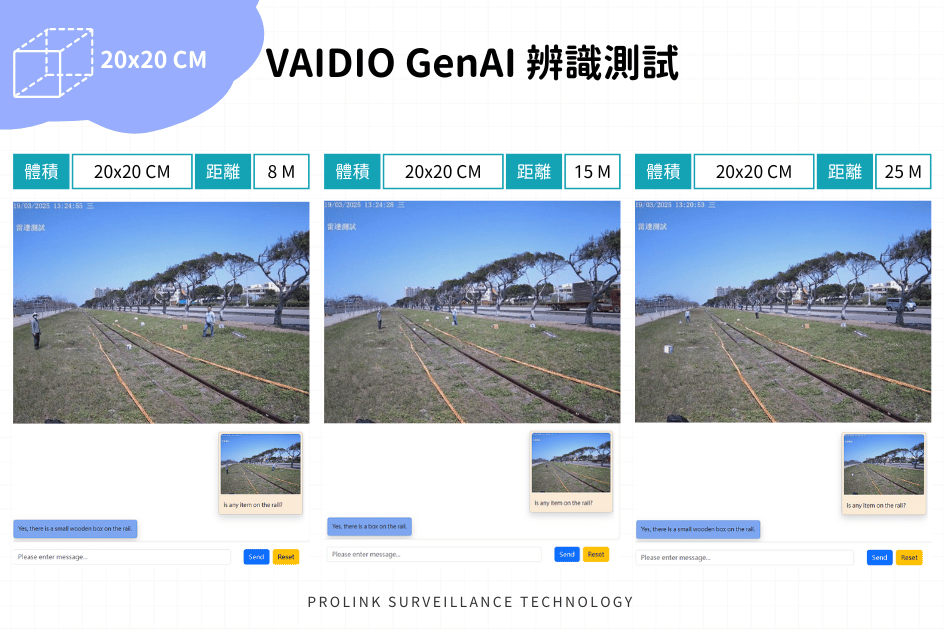
During the test, the user simply asks a natural question, just like in everyday conversation:
“Is any item on the rail?”
Gen AI responds:
“Yes, there is a small wooden box on the rail.”
With no preset commands and no need to manually draw detection zones, the generative AI uses natural language understanding of the scene to autonomously complete foreign object recognition, making the detection process smarter and more intuitive.
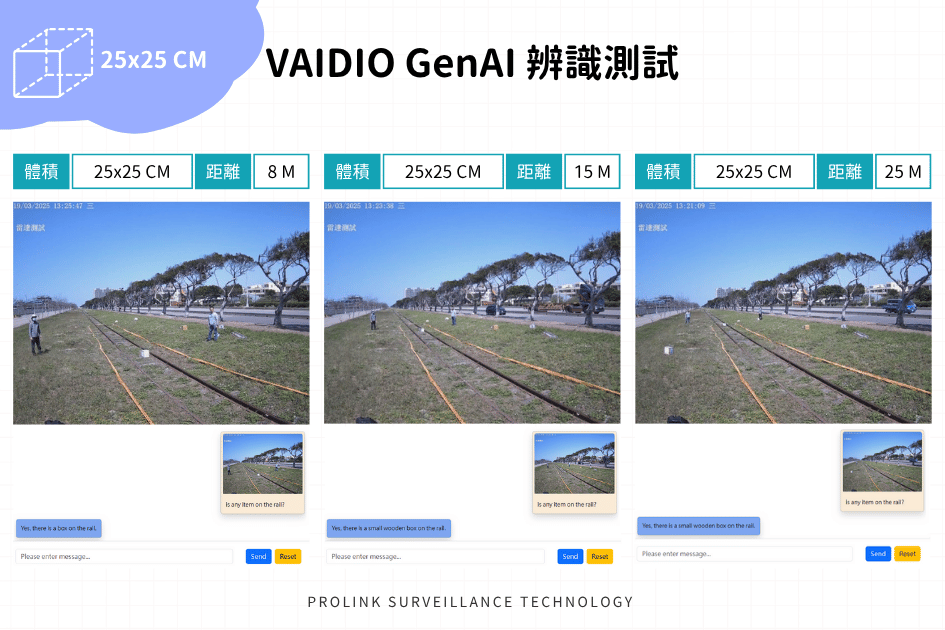
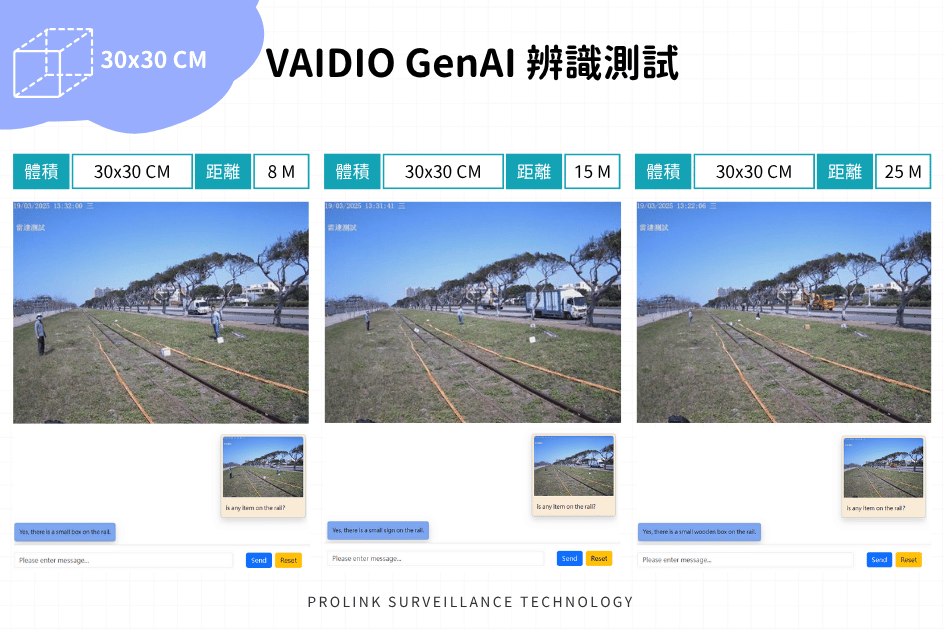
The test results show:
- Radar's detection success rate drops significantly when objects are smaller (e.g., 20×20 cm) or farther away (e.g., 15 or 25 meters).
- Generative AI consistently delivers stable detection even with small objects and long distances, demonstrating excellent scene adaptability and flexibility.
- In real-world environments where object types vary widely and positions are unpredictable, generative AI effectively fills the blind spots of radar detection, providing more comprehensive security protection.

▲ VAIDIO GenAI Understands Scene Content