
Beyond catching traffic violations with smart enforcement, AI can now even automatically detect and report “illegal littering” in real time!
Many people don't realize that CCTV surveillance systems have long been more than just recording tools. Paired with AI video recognition, they can proactively detect violations such as illegal parking, wrong-way driving, or vehicles entering restricted lanes. These are all fixed-pattern events, well suited to “discriminative AI” (often called traditional AI).
How Discriminative AI Works
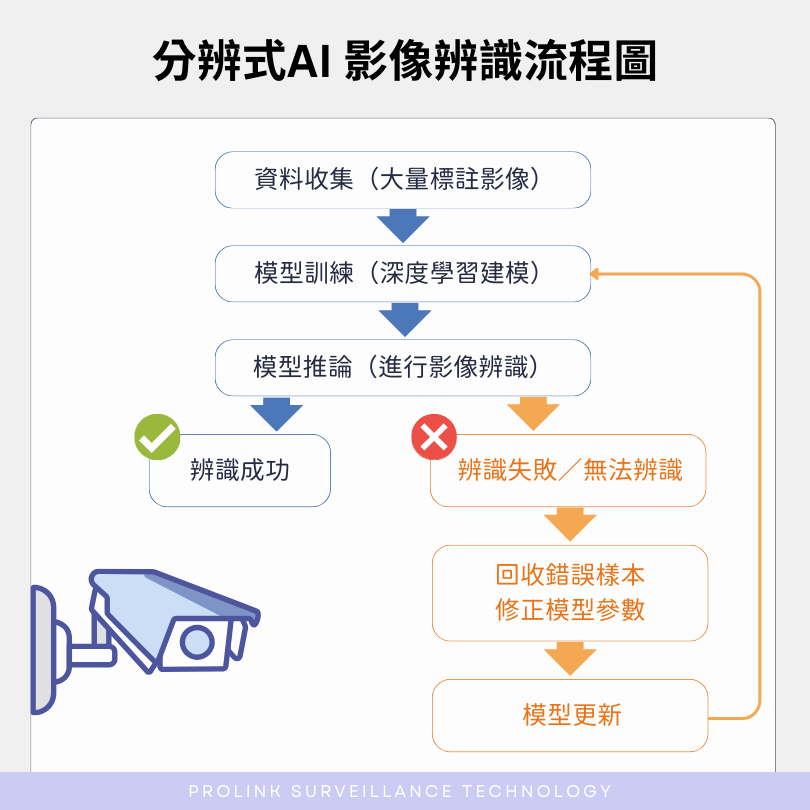
“Discriminative AI” (typically based on a CNN, or Convolutional Neural Network) is trained using large volumes of labeled data. The process is as follows:
STEP 1. Data Collection: Gather large volumes of images and label each object type (e.g., vehicles, people, objects, animals)
STEP 2. Model Training: Build the model through deep learning
STEP 3. Model Inference: AI performs actual recognition based on the training results
STEP 4. Error Correction: If recognition fails or cannot be performed, the erroneous samples are collected and the model parameters are corrected
STEP 5. Model Update: Retrain the model for the next round of inference (and repeat)
Discriminative AI is like an intensively trained inspector, learning from huge numbers of images to tell“what this is and what that isn't”, accurately recognizing that this is a truck, that's a bicycle, what the license plate reads, or what color a car is.
But when it encounters a scenario it “hasn't learned,” it tends to make mistakes or fail to judge at all.
Why Can't It Recognize Non-Fixed Events Like “Illegal Littering”?
But what about non-fixed events? Take “illegal littering” — it looks different every time: a large pink bag of trash, a small black bag, even a discarded chair. Some people dump it openly, others sneak it away. None of this is a clear-cut, easily recognizable pattern, and traditional AI simply has no way to judge it.
How Does Generative AI Solve Traditional AI's Blind Spots?
This is where generative AI (GenAI) comes in! Unlike discriminative AI, which can only match against samples it has “seen before,” it canreason based on context, state, and past experience.
For sudden events without a fixed appearance — fights, traffic accidents, equipment collapses — where everyone's fighting posture differs and accident scenarios vary endlessly, generative AI can extract clues from the footage and make its own judgment.
Traditional AI Is Like a Security Guard; Generative AI Is Like a Manager
To use an analogy, discriminative AI is like a security guard holding a thick training manual that records every suspicious object and action he's been “taught.” The moment he encounters something he hasn't learned, he'll say:“I haven't seen this before — I can't make a judgment.”
Generative AI, on the other hand, is more like aseasoned, adaptablemanager.
Even without being taught step-by-step, this manager can infer abnormal behavior from the conditions on site. Take equipment collapses commonly seen in the news — they're often preceded by signs of tilting or an unstable center of gravity. Generative AI can capture these abnormal dynamics in real time, providing early warning of unusual behavior.
As shown in the image below, taken from a news report of a construction site crane overturning, the time from tilting to collapse was just a few seconds. Notably,even when we focus only on the moment of “slight tilting”,Throughasking in natural language “Is this equipment abnormal?”, generative AI can still independently judge from a single frame that the crane is suspended over soft ground and tilting unstably, and understand that this situation could pose a risk to the operator and site safety.This demonstrates how generative AI can reason from the overall context to identify potential danger and provide early warning of anomalies — without explicit labeling or multi-angle comparison.
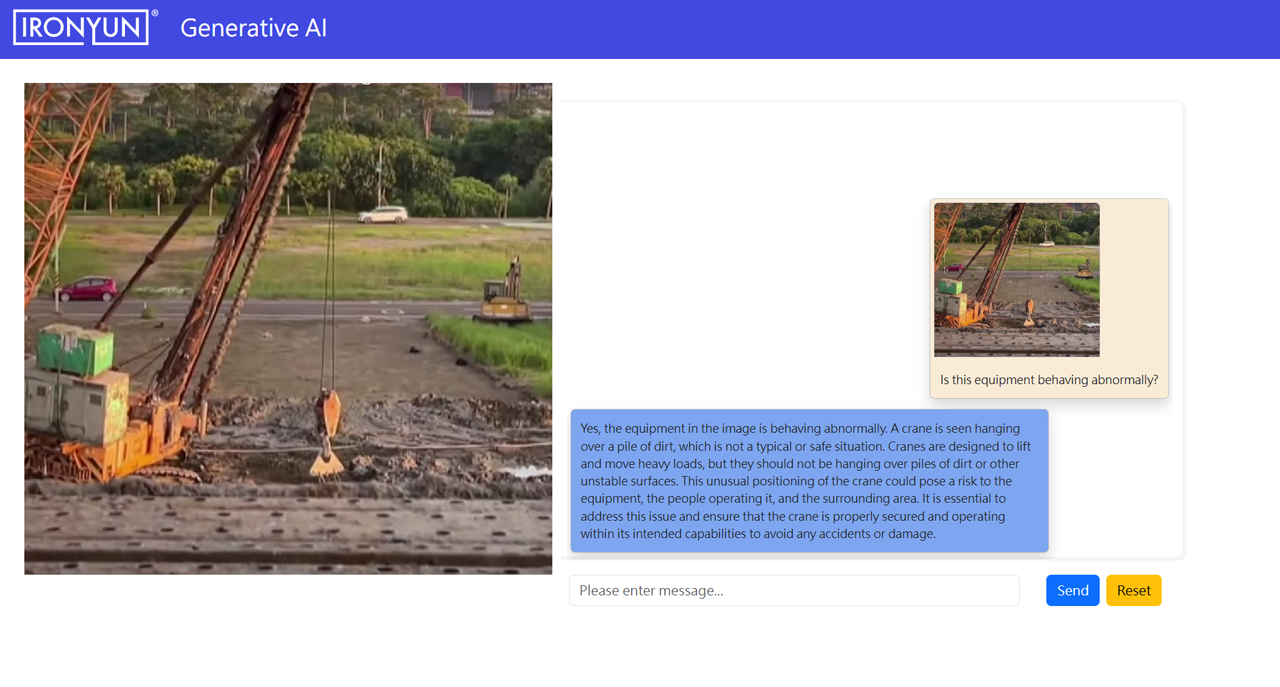
[Earliest Stage] Image 1: Equipment abnormally suspended, showing signs of instability
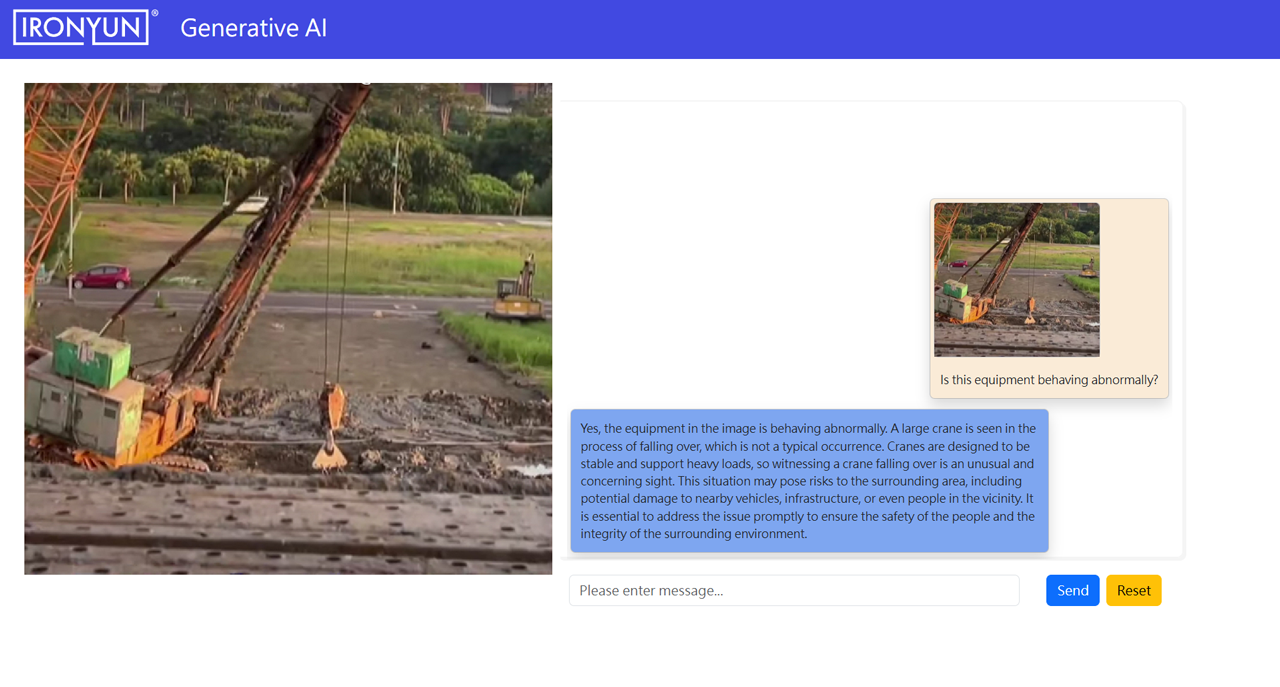
Image 2: Equipment loses balance, tipping begins
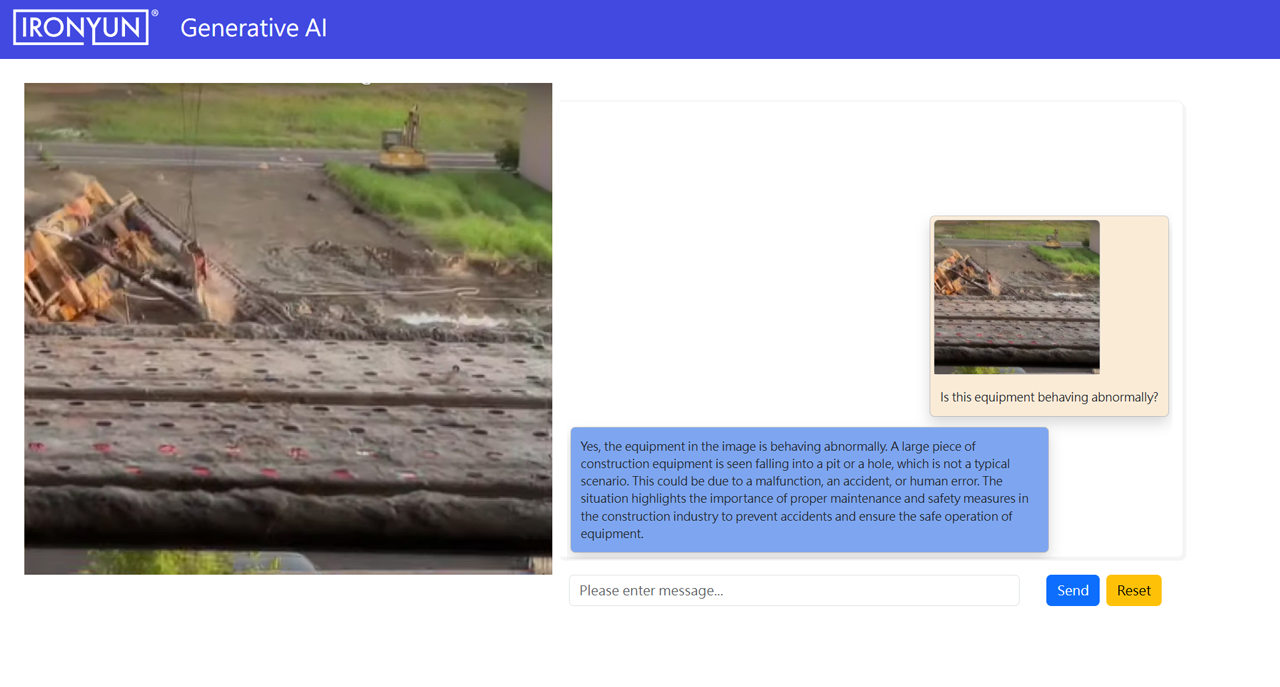
Image 3: Equipment fully overturned, accident occurs
The Advantage of On-Premises Operation: Fast and Secure Without the Cloud
Not all AI, moreover, relies on cloud computing the way ChatGPT or Gemini does.
In places like petrochemical plants, construction sites, or ports, where the network connection is often unstable, if recognition requires sending data to the cloud and waiting for a result, an accident can happen before the alert even sounds.
This is exactly the greatest value of running VAIDIO's generative AI on-premises:
- No need to upload data or wait for a cloud response — the AI understands the scene itself, judges directly, and responds in real time
- Data never leaves the premises, balancing security with real-time performance!
Traditional AI vs. Generative AI: The Differences
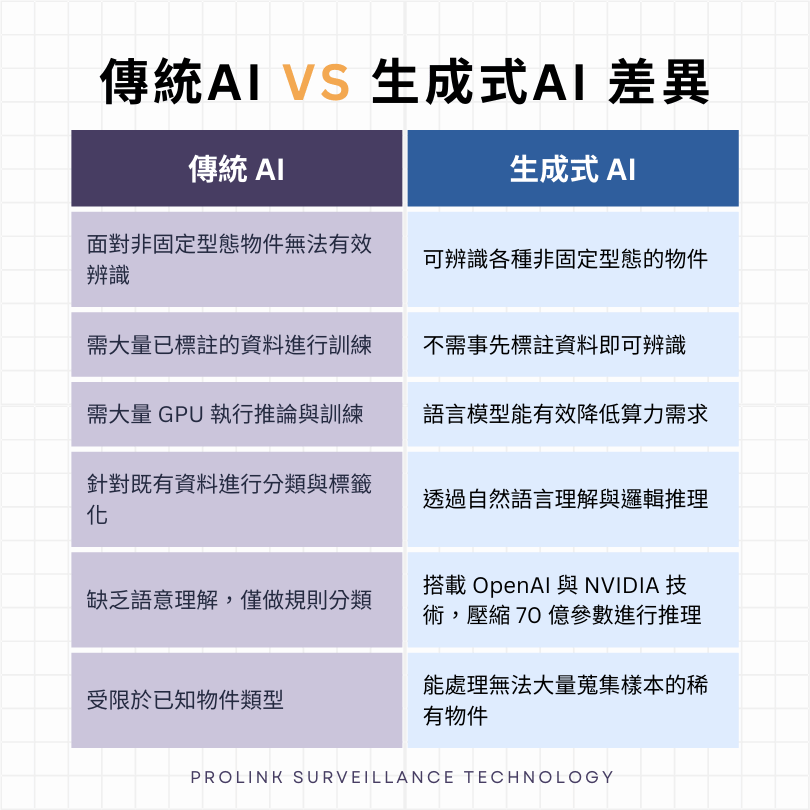
Traditional AI
- Cannot effectively recognize objects without a fixed form
- Requires large volumes of labeled data for training
- Requires substantial GPU resources for inference and training
- Classifies and labels existing data
- Lacks semantic understanding, performing only rule-based classification
- Limited to known object types
Generative AI
- Can recognize objects of any non-fixed form
- Can recognize without the need for pre-labeled data
- The language model effectively reduces compute requirements
- Works through natural language understanding and logical reasoning
- Built on OpenAI and NVIDIA technology, compressing a 7-billion-parameter model for inference
- Can handle rare objects for which large sample sets cannot be collected