
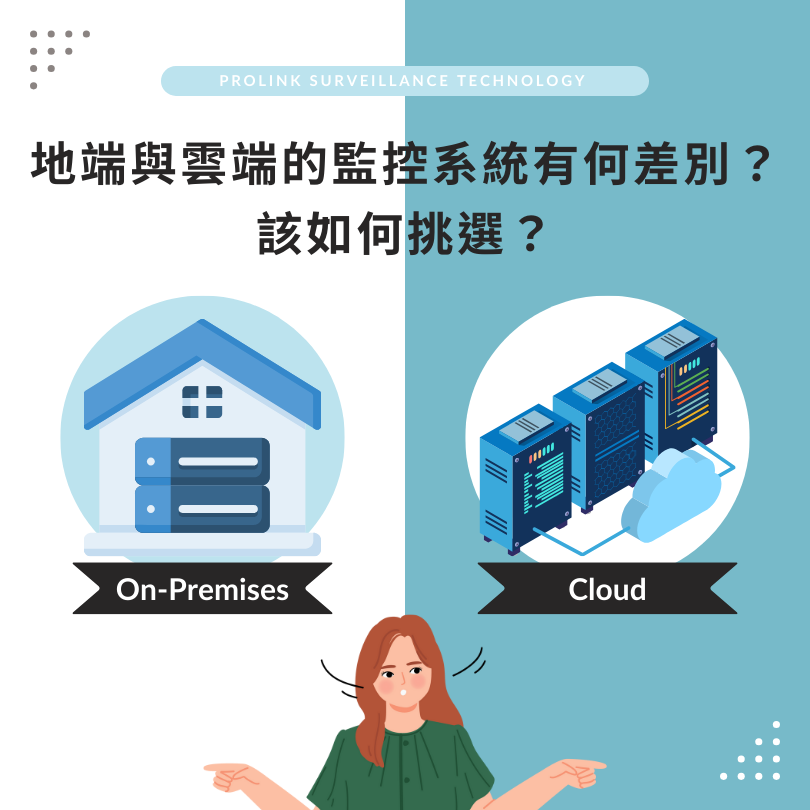
In information technology, “on-premises” and “cloud” are common terms representing two different system deployment approaches and data processing models. Traditional on-premises surveillance systems typically rely on hardware such as hard drives and servers to store and manage recorded footage. As cloud technology and Security as a Service become more widespread, more and more businesses are choosing the cloud for data storage and security management.
Besides choosing between on-premises and cloud systems, businesses can also consider a hybrid cloud surveillance system, which combines the advantages of both to offer greater flexibility and choice. With three options — on-premises, cloud, and hybrid cloud — how should a business choose the surveillance system that best fits its needs? Here are the key considerations to help you make an informed choice!
On-Premises Surveillance Systems
An on-premises surveillance system deploys all hardware and software entirely within the user's own data center or servers, managed and maintained by the business itself. Such a system doesn't depend on external servers or networks — all data processing and storage take place locally, offering the greatest degree of security and data privacy control.
Core Architecture:
- Camera → Video Transmission → Local Storage (e.g., NVR/DVR) → Monitoring Center
Suitable Industries:
Suited to industries with high data privacy requirements, long-term storage needs for large volumes of video, or multi-branch management — such as government agencies, hospitals, financial institutions, military organizations, large enterprises, manufacturers, and retailers.
Advantages of On-Premises Surveillance Systems:
- Data is stored entirely on-site, giving the business full control over it and ensuring privacy.
- Data never leaves the premises, making it ideal for businesses with strict data privacy requirements. With proper management and authorization controls, security risks can be minimized.
- Requires an internal network to connect devices and transmit data, but all storage and processing happen locally, without relying on an external network or cloud service.
- Can be configured for remote access and management via an internal network or VPN, adding an extra layer of security.
Disadvantages of On-Premises Surveillance Systems:
- Higher upfront hardware costs and ongoing maintenance, but lower long-term operating costs.
- Limited scalability if additional hardware needs to be added later.
- Requires dedicated IT staff for maintenance and management, which may increase labor costs.
Cloud Surveillance Systems
A cloud video surveillance system transmits video data over the network to a third-party provider's cloud servers for storage and processing. Users can easily view and manage footage over an internet connection. It's especially well suited to businesses with limited IT resources, effectively reducing local hardware maintenance needs while offering high scalability.
Core Architecture:
- Camera → Video Transmission → Cloud Server Storage → Monitoring Center
Suitable Industries:
Suited to businesses that need scalability and don't require full control over their data — especially SMEs, chain retailers, multinational corporations, logistics companies, and organizations managing operations across multiple regions.
Advantages of Cloud Surveillance Systems:
- No need to invest in extensive hardware, with lower upfront costs and pay-as-you-go pricing.
- Highly flexible scalability — storage space or features can be added anytime as needed, with easy integration.
- Enables remote access and real-time management, ideal for businesses managing multiple locations.
- Maintenance and upgrades are handled by the service provider, reducing the management burden on the business.
Disadvantages of Cloud Surveillance Systems:
- Data is stored in the cloud, creating a strong dependence on network connectivity — a network outage will affect the surveillance system's operation.
- Requires ongoing subscription payments, resulting in higher long-term costs.
- Security depends on the service provider's safeguards, management standards, and security mechanisms, offering weaker control over data privacy.
Hybrid Cloud Surveillance Systems
A hybrid cloud surveillance system combines cloud and on-premises systems, giving businesses more choice and advantages. Cameras connect to the local network, with video data processed and stored on local hardware (such as cameras or video storage devices), while some or all data can also be backed up and stored in the cloud.
Advantages of Hybrid Cloud Surveillance Systems:
- Offers centralized management and remote operation, improving monitoring efficiency.
- Users can choose which video data to store locally and which to store in the cloud based on their needs, offering greater flexibility.
- The on-premises portion provides greater data privacy and control, while still benefiting from the cloud's remote management and access capabilities.
- Data is stored both locally and in the cloud, improving backup and redundancy and reducing the risk of data loss.
Disadvantages of Hybrid Cloud Surveillance Systems:
- Higher initial setup and maintenance costs, as businesses must pay for hardware, network infrastructure, and cloud storage.
- The setup process is more complex and requires managing compatibility and security between both environments, potentially increasing the burden on IT staff.
- The cloud component depends on network connectivity — a network outage or delay can affect data processing, leading to system downtime or lag.