Smart Fencing Solution for Illegal Dumping: AI-Powered Environmental Enforcement, 24/7

Illegal Waste Dumping Is Far More Than Just Trash Left on Vacant Land
Illegal dumping isn't just unsightly mounds of dirt or trash as it looks on the surface -- it can actually contain hazardous industrial waste, which can contaminate thesoil and groundwater, and evenaffect nearby farmland and drinking water safety。
In recent years, illegal dumping has also moved beyond the small-scale "dump and run" of the past, increasingly involvingcross-county transport, nighttime disposal, and organized, crime-style division of laborand other patterns -- perpetrators evendeliberately take detours to avoid surveillance cameras and weigh stations, making it even harder to trace where the waste ends up.Relying solely on traditional manual patrols, stakeouts, or public tip-offs can no longer keep pace with this kind of environmental crime.
What's more, the cleanup afterward is not only troublesome but also costly to restore the environment -- and ultimately, the public ends up footing the bill. As a result, in recent years the government has stopped simply reacting after the fact and has instead startedintroducing AI-powered smart fence monitoring for law enforcement, aiming to detect suspicious illegal activity earlier.
Environmental Law Enforcement Is Going AI
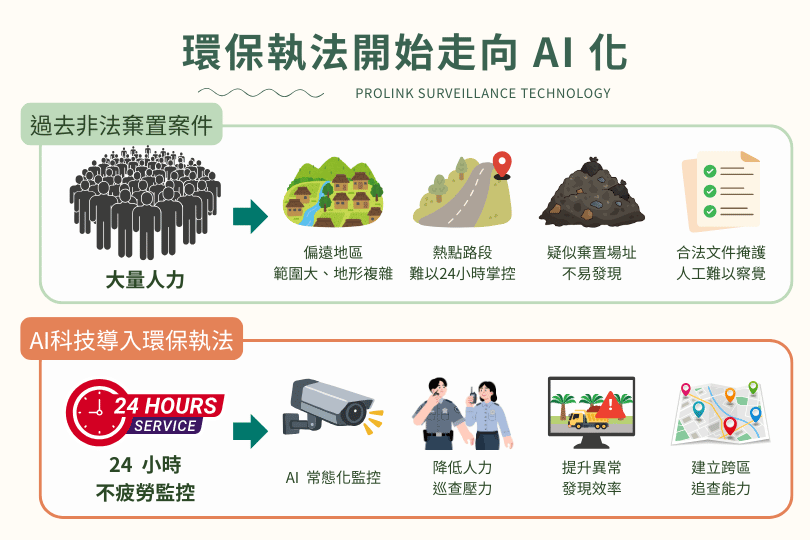
In the past, illegal dumping cases were mainly addressed through manual patrols of remote areas, hotspot routes, or suspected dumping sites -- making it nearly impossible to guard large, geographically complex areas around the clock.
If operators use legitimate paperwork to disguise illegal dumping, manual cross-checking alone makes it very difficult to spot anomalies in time.
To improve enforcement efficiency and address the shortage of manpower, Taiwan's Ministry of Environment has recently begun promotingthe "Illegal Dumping Smart Fence"initiative, planning to invest NT$2.35 billion,bringing AI-powered monitoring into environmental law enforcement as standing infrastructure to complement traditional manual patrols and nighttime stakeouts.
What Is the Illegal Dumping Smart Fence?
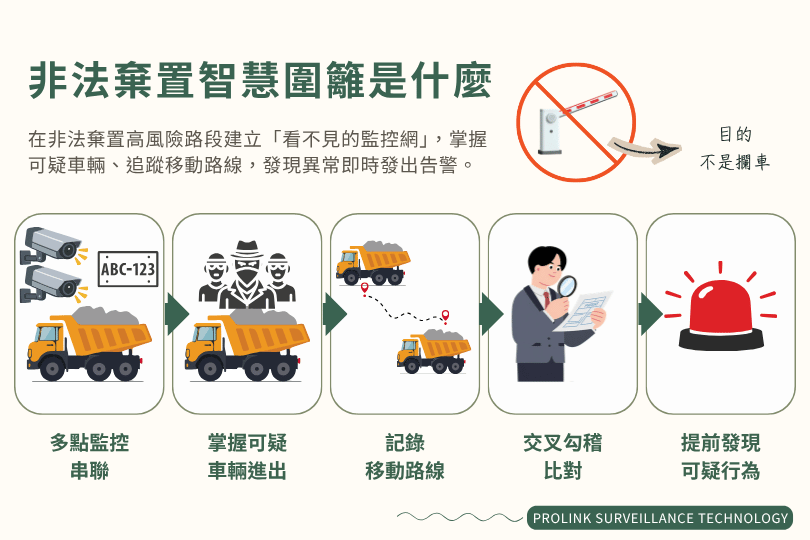
The so-called "Illegal Dumping Smart Fence" isn't about blocking roads with iron barriers -- it works throughcameras, license plate recognition, video transmission, and data integration, building an invisible monitoring network along high-risk routes, cross-referencing abnormal routes with vehicle sighting records to detect suspicious disposal activity in advance. The goal isn't to stop vehicles, but to track suspicious vehicle movements and automatically trigger an alert whenever a vehicle repeatedly appears in a specific area.
Some counties and cities have already begun building and deploying this system, using monitoring equipment at key intersections, expressways, and areas around illegal dumping hotspots to link license plate recognition, truck bed imagery, and vehicle movement records, establishinga "waste flow monitoring network."
The Smart Fence Moves Into the Subsidy and Deployment Phase
The Ministry of Environment's draft "2026 Illegal Dumping Smart Fence Deployment Plan" calls for central government subsidies to local environmental protection bureaus to progressively build out "Illegal Dumping Smart Fence" monitoring points across Taiwan -- showing that this mechanism has moved beyond concept and into actual deployment and implementation. Because illegal dumping vehicles deliberately avoid existing surveillance, the smart fence will be specifically deployed along roads that currently lack CCTV coverage.
▌ Subsidies cover two types of equipment: fixed and mobile:
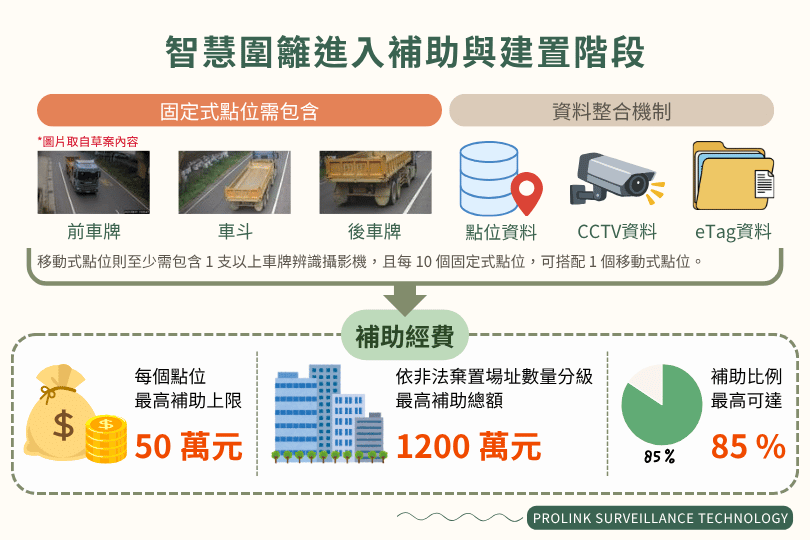
Fixed monitoring points must include: a front license plate camera, a rear license plate camera, and a truck bed camera
Beyond video monitoring, the draft plan also requires establishing a mechanism to integrate site data, CCTV data, and eTag data.
In terms of subsidy funding, each monitoring point can receive up toNT$500,000, and each county or city is tiered based on the number of illegal dumping sites, with the maximum total subsidy reaching NT$12 million, with a subsidy ratio of up to 85%。
Illegal Dumping Vehicles Are Surprisingly Good at "Dodging Surveillance"
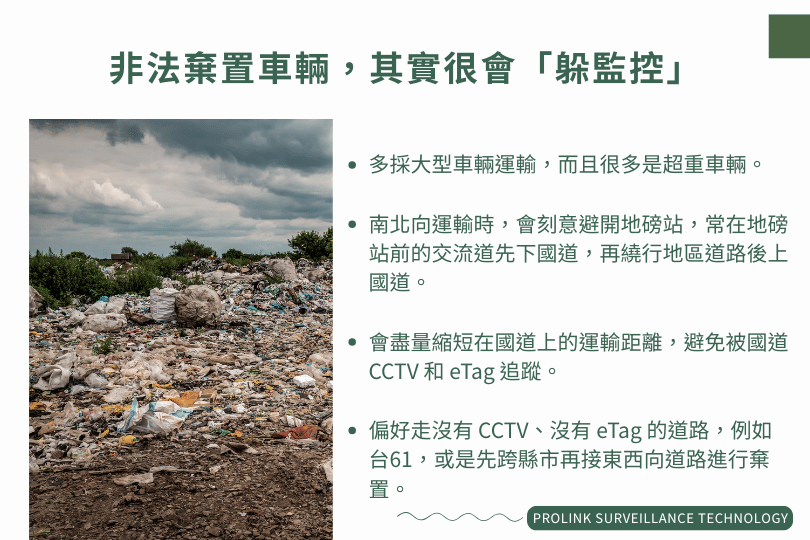
Vehicles used for illegal waste disposal actually show clear transport and detour patterns:
- They mostly use large vehicles for transport, many of which are overloaded.
- When traveling north-south, they deliberately avoid weigh stations, often exiting the freeway at the interchange just before a weigh station, taking local roads around it, and then re-entering the freeway.
- They try to minimize the distance traveled on the freeway to avoid being tracked by freeway CCTV and eTag systems.
- They prefer roads without CCTV or eTag coverage, such as Provincial Highway 61, or they cross county lines first before taking east-west roads to carry out the dumping.
Further Reading:A Major Leap in Weigh Station Inspection Efficiency on National Freeway No. 10! How AI Law Enforcement Successfully Closed the "Weigh Station Evasion Loophole"
Illegal Dumping Hotspots and High-Risk Routes:
- Major North-South Cross-County Transport Routes
such as the freeway, Provincial Highway 61, and several cross-county arterial roads. - East-West Cross-Regional Transport Routesas well as several east-west connector roads.
- Areas Prone to Illegal Dumping
Foothill areas: New Taipei, Taichung, Nantou, and Kaohsiung
Vacant coastal land: Taoyuan. - Traffic routes around waste treatment and recycling facilities.
How Does Vaidio AI Video Recognition Track Illegal Dumping Vehicles?
Older surveillance systems typically recorded around the clock regardless of whether anything was actually happening. Only after an illegal dumping incident occurred would staff go back and review the footage, slowly fast-forwarding and rewinding through dozens of hours of video to find the suspicious vehicle.
Vaidio AI video recognition, on the other hand, flags anomalous events up front.
For example, when a large vehicle enters a restricted area late at night, the system automatically saves the relevant footage, eliminating the need to store hours of empty footage with no events and reducing storage pressure -- a difference that has become even more noticeable as hard drive prices continue to rise in recent years.
The way footage is retrieved has also changed.
In the past, reviewing surveillance footage was like rewinding a videotape, searching slowly by time; now it's more like using a search engine. Simply enter criteria such as a specific license plate, vehicle color, or even a person's characteristics, and the key footage is found instantly.
The biggest difference is that traditional surveillance typically looks back for footage after something has already happened, while AI flags suspicious events and proactively issues alerts the moment an anomaly occurs.
Vaidio, an AI video recognition system from Taiwan's Vaidio Corporation that has repeatedly won SIA New Product Showcase Awards, combines NVIDIA GPU-accelerated computing and can be deployed at mountain entrances, remote roads, or around illegal dumping hotspots as a round-the-clocksmart virtual fence。
The system can also add AI recognition to existing IP cameras, improving tracking and evidence-gathering efficiency without a major overhaul of existing surveillance equipment, while lowering overall deployment costs.
(The following is footage from an actual field test)
▲ Vaidio's video search feature can search by vehicle type and combine license plate recognition with multiple camera locations to automatically trace a vehicle's movement path, without relying on eTag.
Vaidio's Illegal Dumping Smart Fence Solution
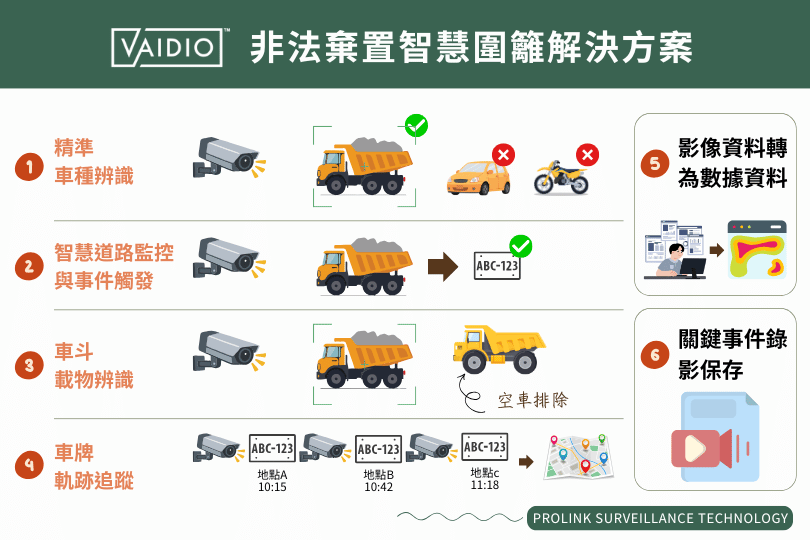
- Precise Vehicle Type Recognition:Automatically identifies different vehicle types, with a particular focus on large heavy-duty trucks, avoiding false positives from ordinary cars or unrelated vehicles.
- Smart Road Monitoring and Event Triggering:Front and rear license plate recognition is only triggered when a large vehicle is detected passing by, reducing unnecessary processing load and false alerts.
- Truck Bed Cargo Detection:Determines whether the truck bed is carrying cargo, reducing false alarms caused by empty trucks or ordinary traffic, while using the cargo status to provide additional contextual clues for faster filtering of suspicious vehicles.
- License Plate Trail Tracking:License plate sighting records from different monitoring points can be queried and cross-referenced later. Law enforcement personnel can quickly pull up records of a vehicle entering or exiting a specific area, lingering abnormally, or appearing repeatedly, tracking a suspicious vehicle's movements without relying entirely on eTag.
- Converting Video Data into Analyzable Data:Converts abnormal traffic patterns, dwell records, and event logs into analyzable data to help identify new illegal dumping hotspots.
- Key Event Recording and Retention:The system automatically organizes alert events and anomalous clips, making it faster to locate the footage needed for inspections, retrieval, or evidence afterward.