
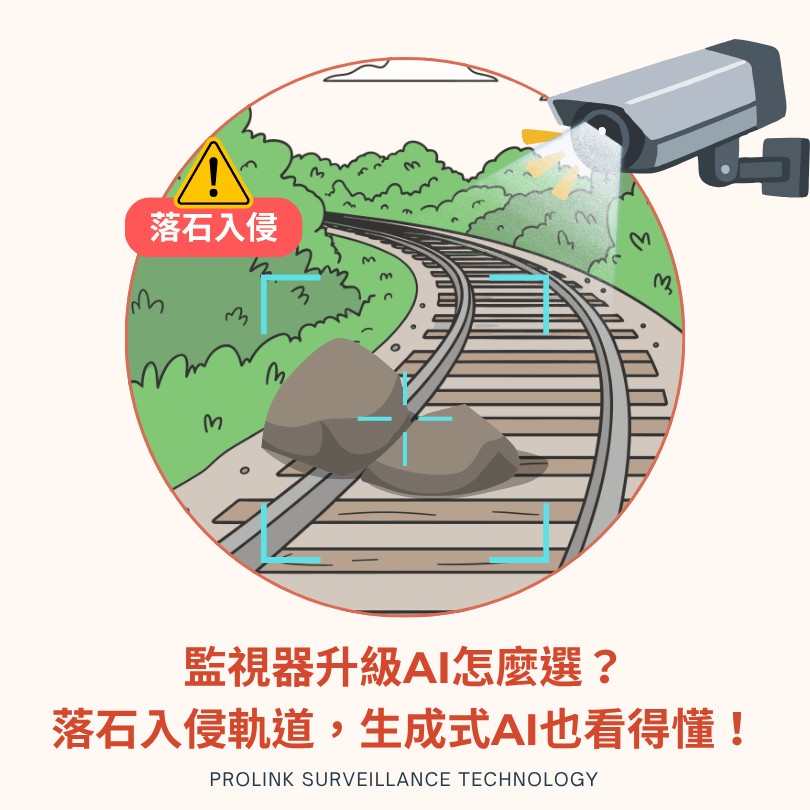
In daily life, we are increasingly accustomed to AI assisting with a wide range of tasks, and surveillance systems are no exception.
For example, factories use PPE detection to confirm whether workers are wearing helmets and reflective vests; long-term care centers use fall detection so caregivers can spot incidents immediately; and large performing arts centers use crowd analytics to prevent crushes from overcrowding.
The goal of these AI applications is the same: to catch anomalies before they escalate, compensating for limited staffing, fatigue, and blind spots.
Seeing Is Not Understanding: What Traditional AI Lacks Is Contextual Judgment
Most common AI video recognition today is built on training with large volumes of data.
Take helmets as an example: AI is trained on large numbers of helmet images from different angles, lighting conditions, and colors. As long as a person appears within the range the model has learned, it can quickly determine whether they are wearing a helmet as required.
Traditional AI isn't inferior — its capability simply comes from its training data. It excels at recognizing targets it has already learned, such as helmets, reflective vests, falls, or vehicles. As long as a scenario falls within what it has learned, it typically delivers stable, accurate results.
A Thought Experiment:
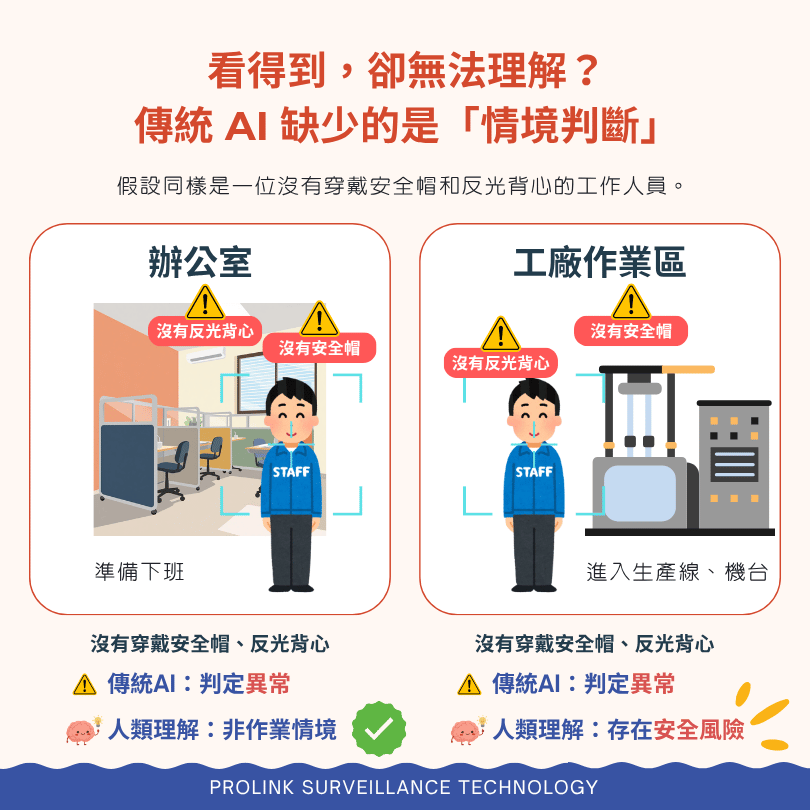
Consider the same worker without a helmet or reflective vest.
- Standing in the office, they may simply be about to leave for the day.
- Standing in a factory work area, it represents a safety risk.
A person can tell the difference at a glance, but traditional AI excels at “recognizing targets,” not “understanding context.” It can detect the absence of a helmet, but it cannot judge, as a human would, where the lack of protective gear actually constitutes a safety risk. This is precisely why generative AI is now being introduced into smart surveillance.
Generative AI Is Better Suited to Events Without a Fixed Pattern
While the camera still does the “seeing,” generative AI takes on the role of the “brain,” beginning to understand what is actually happening in the scene.
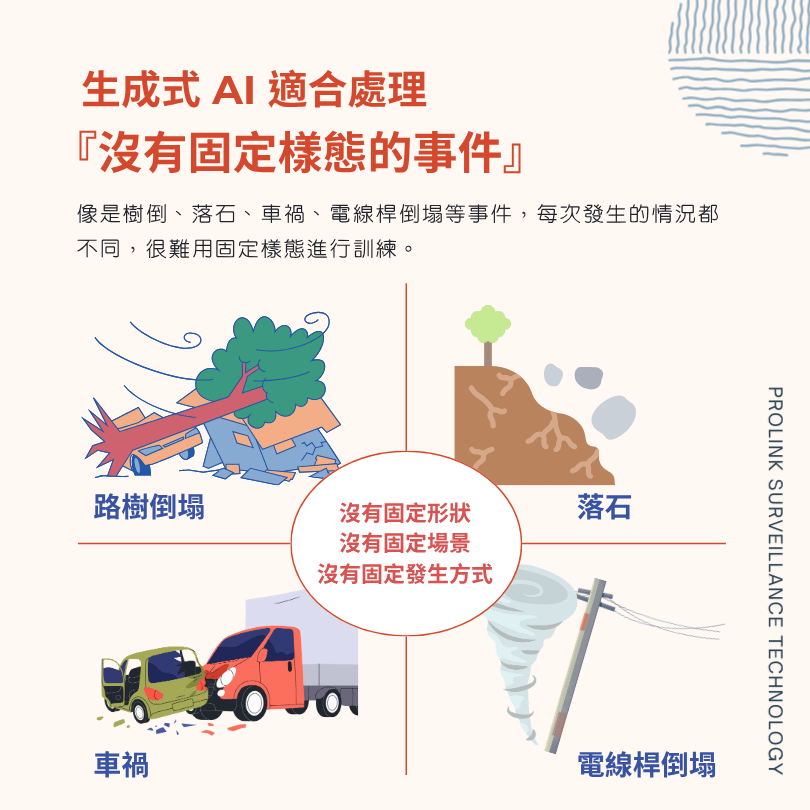
The value of generative AI becomes especially clear for events without a fixed pattern — natural disasters, fallen trees, rockfalls, traffic accidents, or toppled utility poles. Each occurrence looks different, making it difficult to train on a fixed pattern.
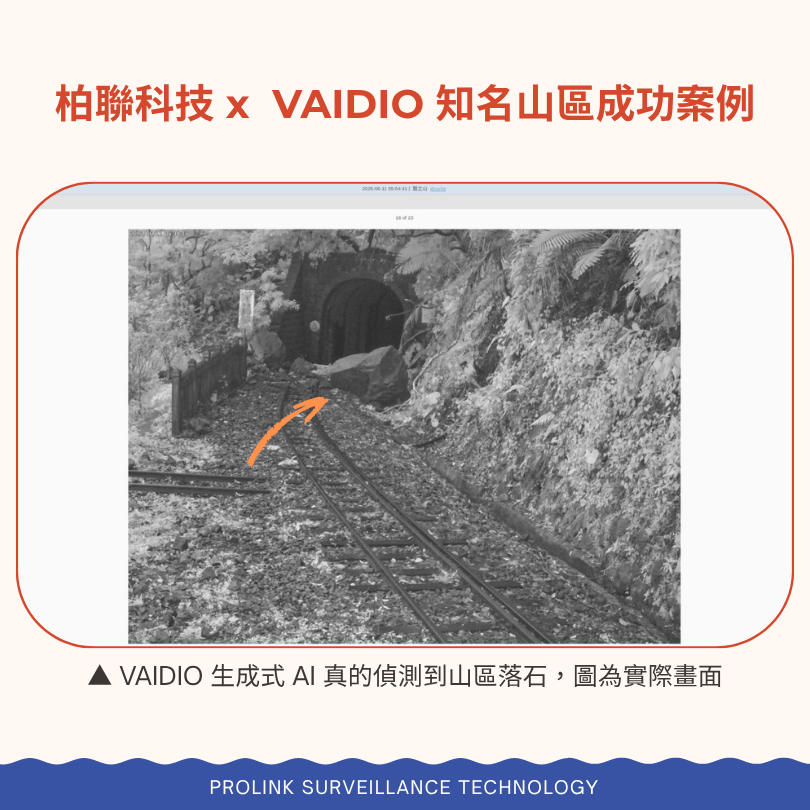
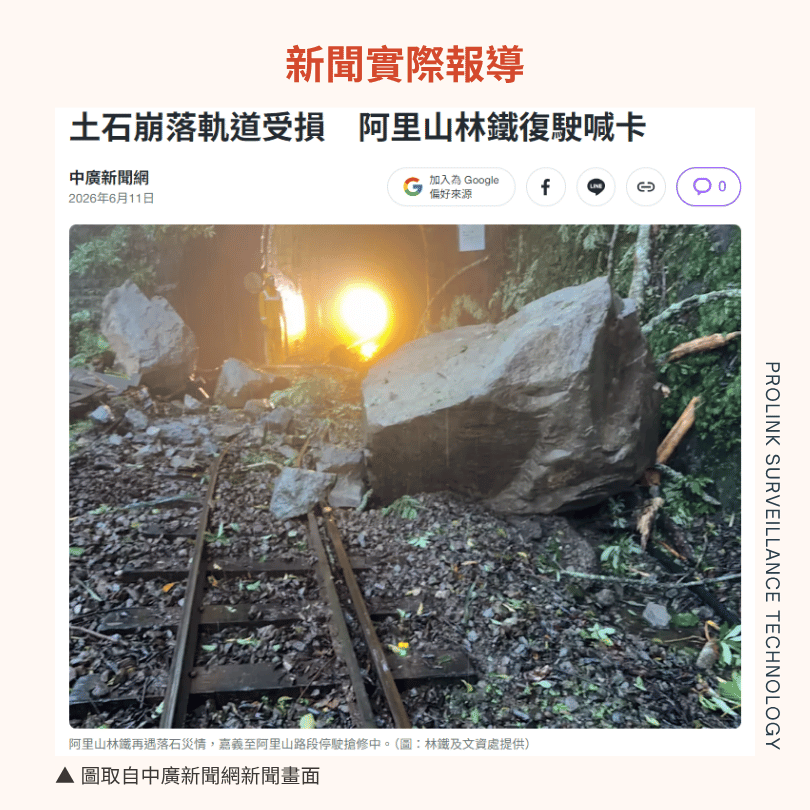
Take Pro-Link's well-known mountain railway foreign object intrusion project as an example— heavy rain in recent periods has frequently caused rockfalls, fallen trees, and sediment buildup along the tracks.
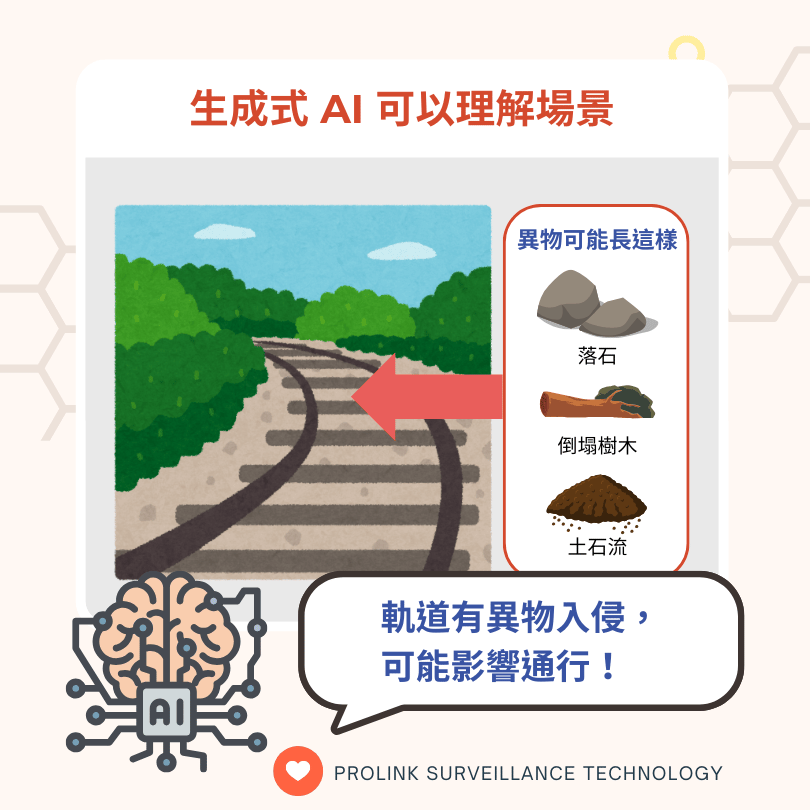
These foreign objects look different every time — sometimes a large boulder, sometimes a pile of debris; sometimes a fallen branch, sometimes a mudslide covering the track.
All of these can disrupt operations, but it's nearly impossible to collect every scenario in advance to train traditional AI. Scenarios like this, which require understanding on-site conditions before judging whether a danger exists, are ideal for generative AI. There is no need to station staff around the clock, and no extra personnel are needed on holidays.
At this well-known mountain site, Tieyun Technology'sgenerative AIis used for track foreign-object detection, and behind it is the LLaVA technology that has drawn attention in recent years.
What Is LLaVA?
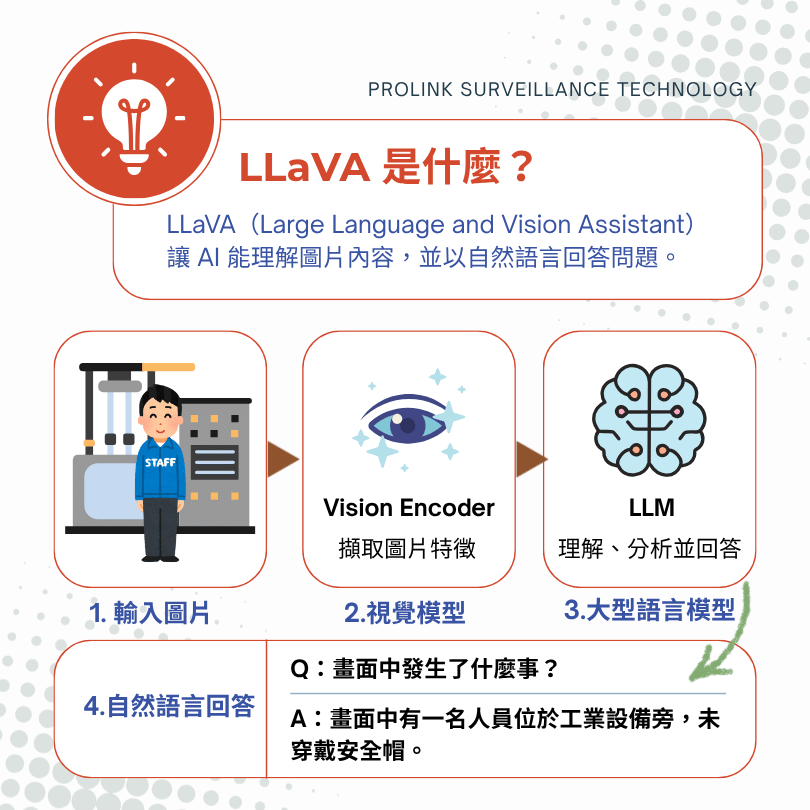
The team behind LLaVA (Large Language and Vision Assistant) initially set out to give large language models the ability to understand not just text but also images, and to answer questions about those images.
At the time, GPT-4 had already demonstrated powerful multimodal capabilities — understanding text and images together — but its model details were not public. The research team therefore sought to achieve similar visual conversation capabilities using open-source models.
To achieve this, LLaVA combines a vision encoder with a large language model (LLM), enabling AI not only to recognize objects in a scene but also to understand image content and answer questions in natural language.
This technology has since extended into areas such as smart surveillance, document parsing, factory inspections, and enterprise multimodal AI assistants.
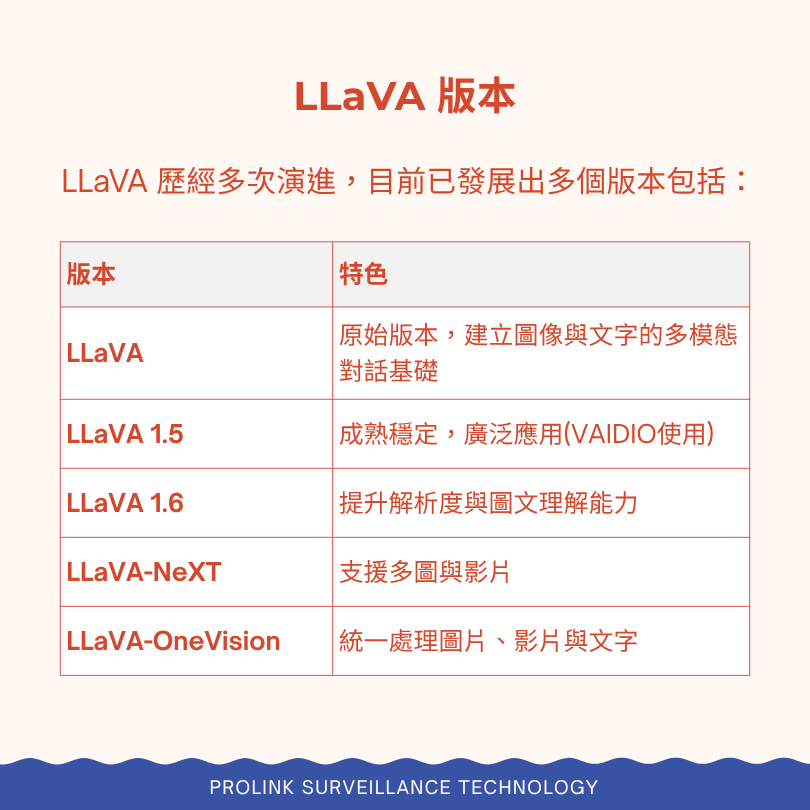
LLaVA has evolved through multiple iterations and now includes several versions, such as:
3 Key Advantages of LLaVA in Smart Surveillance
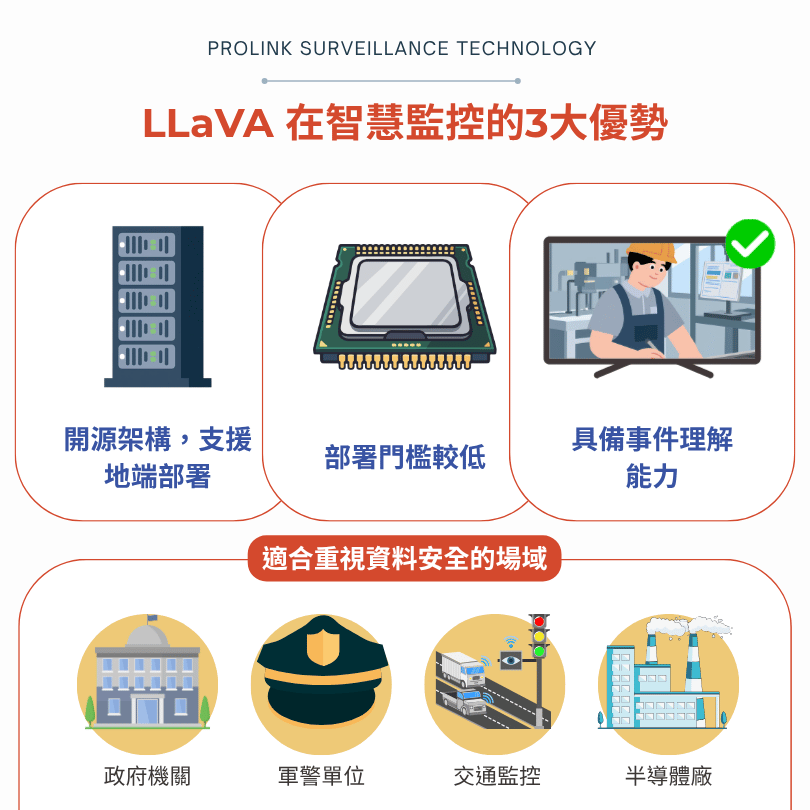
1. Open-Source Architecture Supporting On-Premises Deployment
Unlike commercial models such as GPT-4o, Gemini, or Claude, which require a connection to cloud services, LLaVA's open-source architecture can be downloaded and deployed independently, without sending data to an external cloud. This makes on-premises AI systems especially suitable for government agencies, police and military units, traffic monitoring, semiconductor fabs, and other data-security-sensitive environments.
2. Lower Deployment Barrier
LLaVA 1.5 is available in model sizes such as 7B and 13B. Even the 7B model delivers solid image understanding, balancing computational efficiency while lowering the barrier for enterprises to adopt generative AI.
3. Event Understanding Capability
LLaVA does more than see the people, vehicles, or objects in a scene — it understands the event itself, converting video into natural language descriptions. Paired with real-time detection models like YOLO, it can be applied to helmet recognition, fall detection, smoke and flame detection, people counting, and anomaly analysis, forming a complete AI visual analytics system.
VAIDIO Generative AI System Architecture
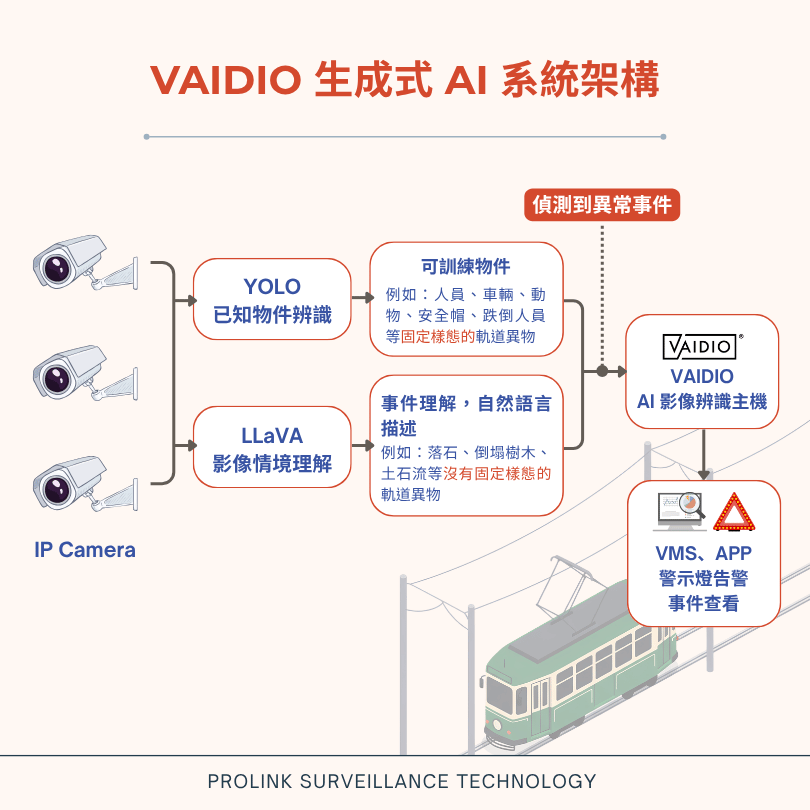
In VAIDIO's generative AI architecture, YOLO's real-time detection model is primarily responsible for recognizing previously trained targets, such as people, vehicles, animals, helmets, or falls. These events have clear, defined characteristics, enabling fast recognition and alerting.
But situations like rockfalls, fallen trees, or sediment from mudslides look different every time, making them hard to define into fixed categories in advance. This is where LLaVA takes over, understanding the scene content and converting what it sees into a natural language description to help determine whether the situation affects passage or poses a risk.
Finally, VAIDIO integrates the analysis results from both AI types and notifies managers to review the event via the VMS, a mobile app, or an alert device.
Pro-Link x VAIDIO: A Notable Mountain Railway Case Study
Tieyun Technology's VAIDIO deployment uses the mature, stable LLaVA 1.5 architecture with a 7-billion-parameter (7B) model, moving AI video recognition from pure “detection” to “understanding.” It can describe scene content and further grasp the context behind an event to identify suspicious objects.
Schedule An Appointment
Need product recommendations or technical consultation?
Contact us, and we'll provide professional advice and product information